





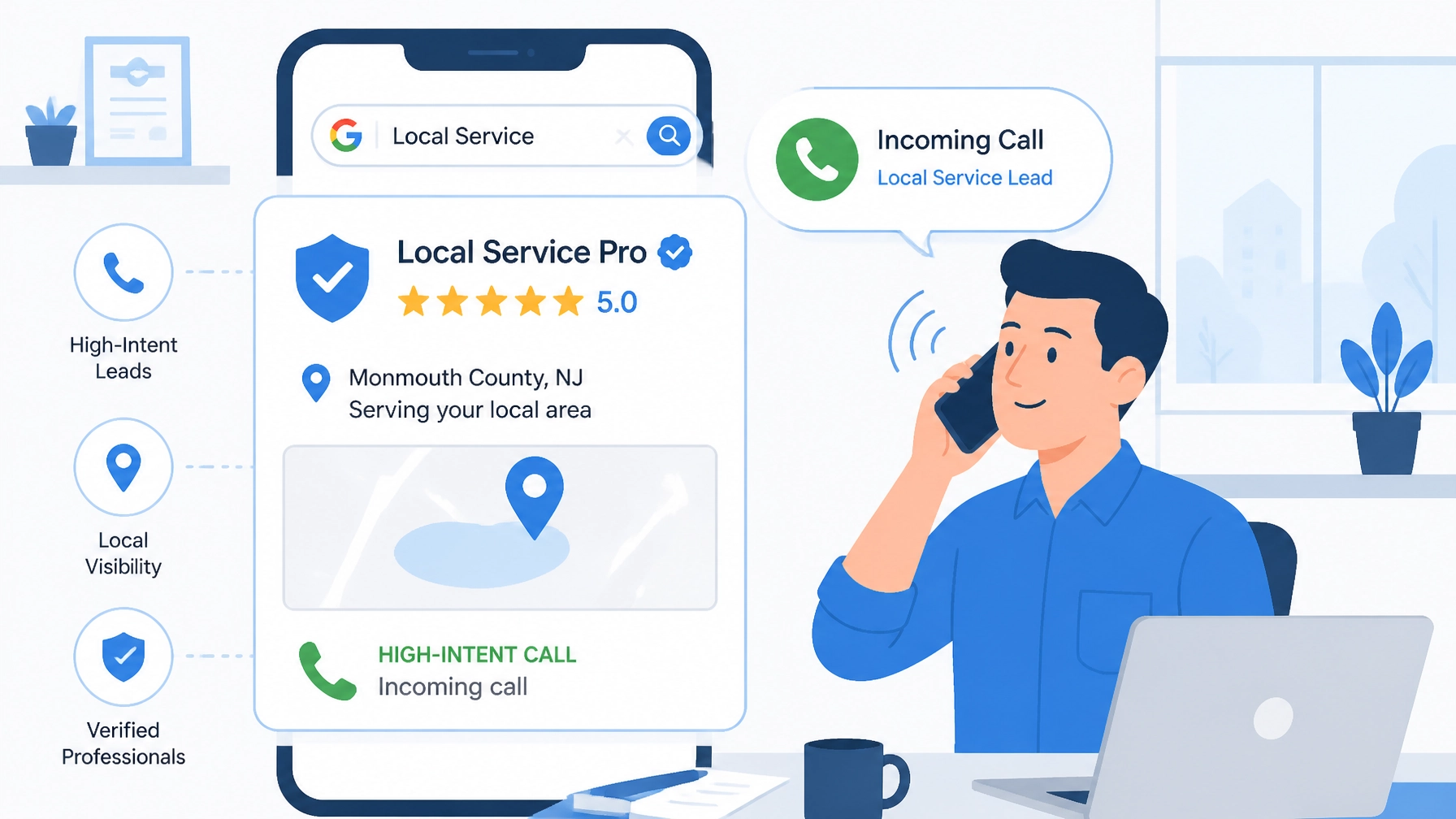
If your service business needs more booked jobs, you need more than raw lead volume. You need qualified conversations with customers who are ready to act.
For many local businesses in Monmouth County, a live phone call creates a faster path to revenue than a filled-out form. The customer explains the problem. Your team qualifies the opportunity. You can schedule the appointment immediately.
That does not make forms irrelevant.
Meta Ads can generate both high-quality lead forms and phone calls through targeted campaigns. Google Local Services Ads (LSA), however, specialize in capturing high-intent prospects who are already searching for a local provider.
The strongest strategy is not always calls versus forms.
It is knowing when to use each channel, how to measure the difference, and how to build one revenue-generating system around both.
Capture High-Intent Calls with Google Local Services Ads
Google Local Services Ads place eligible businesses near the top of local search results when potential customers search for specific services.
That matters because the customer is not casually browsing social media. They are actively looking for help.
A search such as:
- “HVAC repair near me”
- “emergency plumber in Freehold”
- “roofer in Manalapan”
- “electrician near Wall Township”
- “landscaper in Colts Neck”
signals immediate or near-term intent.
Google describes LSAs as a pay-per-lead solution for local service businesses. Customers can contact you through the ad by phone, message, or booking request. Depending on your category and setup, the ad can also display trust signals such as Google screening or verification badges.
Why LSA calls are powerful
A live call compresses the customer journey. Instead of sending someone to a landing page and waiting for a response, you can handle the opportunity in real time.
The call gives you the chance to:
- Confirm the customer’s location and service need
- Answer questions immediately
- Establish trust through a real conversation
- Explain pricing or next steps
- Schedule an appointment before the customer contacts a competitor
- Identify urgent, high-value opportunities
The 2025 Invoca Home Services Call Conversion Benchmarks Report analyzed more than 60 million phone calls across industries. Home services led the categories measured, with approximately 46% of qualified phone leads converting during the call into a booked job, appointment, or similar revenue action.
That is not a guarantee for every Monmouth County business. It is a benchmark showing why qualified calls often outperform passive lead capture.
Use Meta Ads to Generate Forms: and Drive Calls
Meta Ads give you a different kind of control.
Facebook and Instagram allow you to target audiences based on location, demographics, interests, behavior, engagement, and prior interactions with your business. You can reach people before they search for a provider, while they are researching a problem, or after they have already visited your website.
Most importantly, Meta is not limited to filled forms.
Meta campaigns can support:
- Instant lead forms
- Website conversion campaigns
- Click-to-call campaigns
- Retargeting campaigns
- Appointment and booking campaigns
- Video and image campaigns that build demand
- Follow-up campaigns for people who did not convert initially

When Meta lead forms make sense
Meta Instant Forms reduce friction. A prospect can submit contact information directly inside Facebook or Instagram without waiting for a website to load.
Forms work well when:
- The customer is comparing providers
- The service requires a quote or consultation
- You need project details before calling back
- The customer is not ready to speak immediately
- Your team has a reliable rapid-response process
- You are promoting a seasonal offer or free estimate
However, low-friction forms can also create more curiosity-driven inquiries. A person may submit a form because the offer looks interesting, not because they are ready to book.
That is why form quantity is not the same as business value.
Use higher-intent forms with qualifying questions such as:
- What service do you need?
- What town are you located in?
- When do you need help?
- What is the approximate project size?
- What is the best time to contact you?
When Meta call campaigns make sense
Meta can also drive phone calls directly. Call-focused campaigns are particularly useful for urgent or personal services where customers benefit from immediate assistance.
Consider call campaigns for:
- Emergency home repairs
- Medical and dental consultations
- Legal intake
- Senior care
- Auto repair
- Pest control
- High-value home improvement
- Local businesses with staff available to answer calls
The key difference is intent. Meta can create demand and capture consideration. A call campaign can move that prospect into a live sales conversation faster.
Compare Calls and Forms by Revenue: not Volume
A form may be cheaper than a call. It may also produce more reported leads. That does not automatically make it more profitable.
You need to compare the complete funnel.
| Metric | Google LSA Calls | Meta Lead Forms | Meta Call Campaigns |
|---|---|---|---|
| Typical intent | High; active local search | Mixed; discovery to consideration | Mixed to high, depending on targeting |
| Primary action | Phone call or contact request | In-platform form submission | Phone call |
| Main advantage | Immediate conversation | Scalable, low-friction capture | Targeted call generation |
| Main risk | Missed or unqualified calls | Low-quality or non-responsive leads | Weak creative or poor audience fit |
| Best success metric | Booked jobs and revenue | Qualified leads and booked jobs | Qualified calls and bookings |
For broader Google search advertising, LocaliQ’s 2025 home services benchmark analyzed 3,211 campaigns running between April 2024 and March 2025. The benchmark reported:
- 7.33% average conversion rate
- $7.85 average cost per click
- $90.92 average cost per lead
These figures apply to search advertising broadly, not exclusively to LSAs. They demonstrate the competitive economics of local service marketing.
The right question is not:
“How many leads did we generate?”
Ask instead:
- How many calls were answered?
- How many calls were qualified?
- How many forms received a response?
- How many leads booked an appointment?
- How much revenue came from each channel?
- What was the cost per booked job?
- How quickly did your team follow up?
A channel that produces 20 leads and 8 booked jobs is stronger than one that produces 100 leads and 3 booked jobs.
Build a Call-First Conversion System
Calls only convert when your business is ready to receive them.
A missed call is not a harmless inconvenience. It can send a high-intent customer directly to a competitor.
Build a call-first system with these components:
1. Answer during your advertised hours
If you run ads during times when no one answers, you are paying to create frustration. Align campaign schedules with actual staffing.
2. Use dedicated tracking numbers
Track calls by source, campaign, location, and service. This allows you to distinguish LSA calls from Meta calls, organic calls, and repeat customers.
3. Define a qualified call
A qualified call should meet clear criteria, such as:
- Correct service area
- Relevant service need
- Minimum project value
- Valid timeframe
- Genuine buying intent
4. Train your team to book
Your receptionist or sales representative should know how to ask discovery questions, explain next steps, and request the appointment.
5. Respond to forms immediately
Forms require follow-up. Speed matters. A lead contacted within minutes is more valuable than one contacted the next day.
6. Track revenue back to the source
Connect your CRM, call tracking, and advertising platforms. Meta supports optimization toward conversion leads when quality outcome data is available through CRM integrations or Conversions API workflows. Do not optimize only for cheap form submissions.

Combine Google LSA and Meta Ads to Own the Local Funnel
Google LSA and Meta Ads solve different problems.
LSA captures customers who are searching now. Meta reaches customers earlier, creates demand, builds familiarity, and brings previous visitors back into the conversation.
Together, they create a stronger local marketing engine:
- Use LSA to capture urgent, high-intent searches.
- Use Meta Ads to reach defined local audiences.
- Use forms for quote requests and structured inquiries.
- Use Meta call campaigns for services that benefit from immediate conversations.
- Retarget website visitors and unconverted prospects.
- Measure booked jobs and revenue across every source.
This integrated approach is especially valuable for businesses serving multiple Monmouth County communities, including Freehold, Howell, Manalapan, Wall Township, Colts Neck, and surrounding areas.
Partner with SEOPulseAI to Turn Leads into Revenue
You do not need another disconnected vendor managing one channel in isolation. You need a growth partner that understands targeting, tracking, landing pages, lead quality, and follow-up as one system.
SEOPulseAI combines digital marketing strategy with conversion optimization. Our conversion optimization services include landing page improvement, form optimization, user behavior analysis, A/B testing, messaging refinement, and trust-signal integration.
Our company reports more than:
- $25 million in client revenue generated
- 185% average traffic growth
- 97% client retention
One SEOPulseAI CRO testimonial from Lisa Campbell, Marketing Director at a SaaS company, reports a 42% increase in lead conversion rate after A/B testing headlines and trust signals. Another client, Michael Roberts, Founder of a consulting firm, reports a 75% increase in qualified leads after landing page and call-to-action optimization.
Results vary by industry, offer, competition, and follow-up process. The principle remains consistent: optimize for qualified opportunities and booked revenue: not vanity metrics.
If you operate a local service business in Monmouth County or beyond, let’s determine whether Google LSA, Meta lead forms, Meta call campaigns, or a coordinated mix will produce the strongest return.
Partner with SEOPulseAI for a free, no-obligation paid media strategy review. We will help you build a measurable system that turns more searches, clicks, calls, and forms into paying customers.