





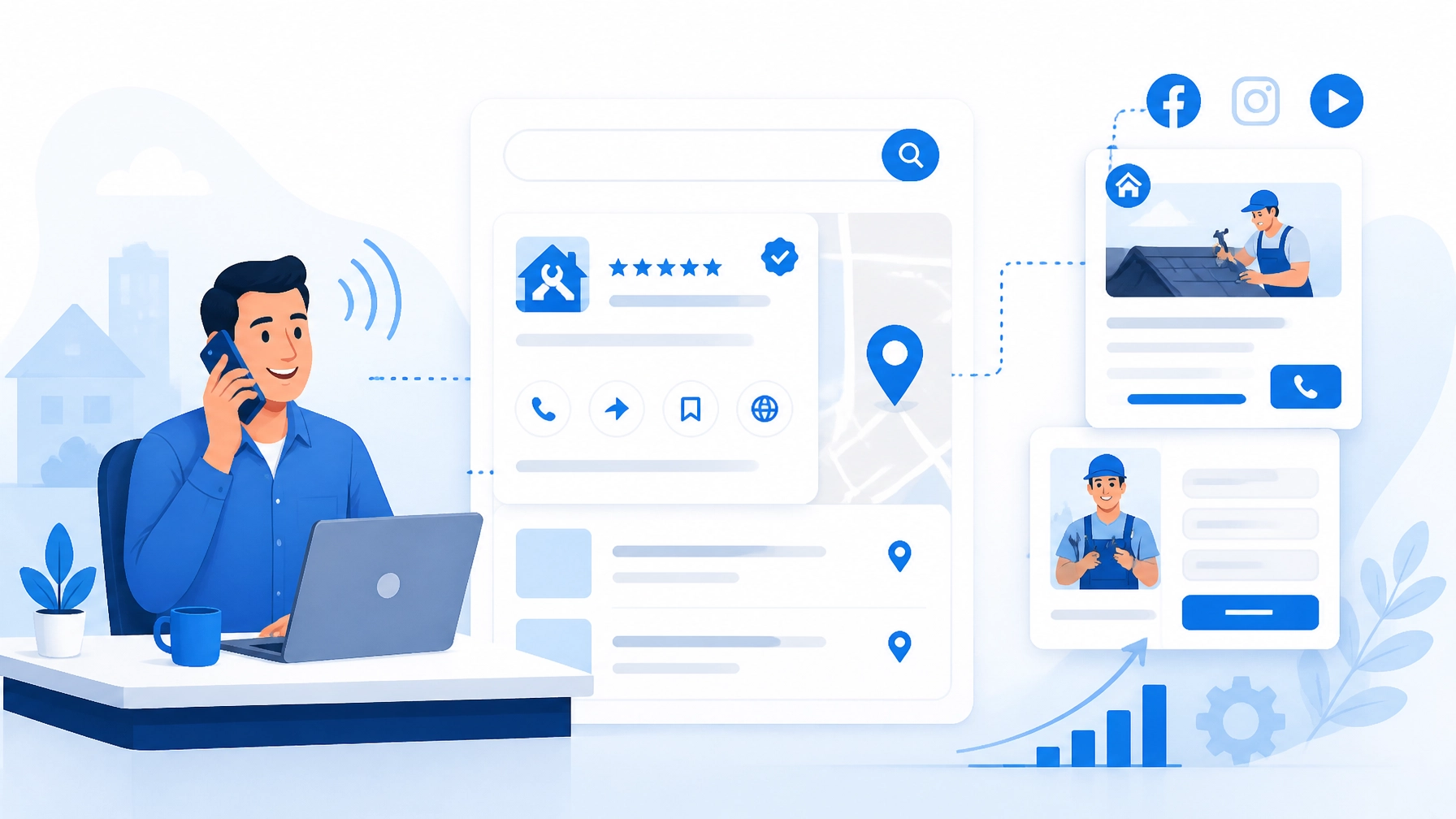
Your next customer is already looking for help: or discovering that they need it. Your growth strategy must reach both prospects.
For service businesses in Monmouth County, NJ, and beyond, the strongest advertising systems combine high-intent demand capture with full-funnel audience development. Google Local Services Ads (LSAs) connect active searchers directly with your business. Meta Ads introduce your services to targeted audiences, generate lead forms, and drive phone calls through Facebook and Instagram.
These channels solve different problems.
Google LSA captures urgency. Meta Ads create demand, build familiarity, and generate both leads and calls. Together, they create a revenue-generating machine for contractors, HVAC companies, plumbers, electricians, home service providers, legal practices, medical businesses, and other local service companies.
Build a Two-Channel Growth Engine
Your prospects do not all take the same path to purchase.
One homeowner searches “emergency plumber near me” and calls the first trusted provider who answers. Another sees a Facebook video about seasonal HVAC maintenance, clicks a lead form, and requests an estimate several days later.
If you advertise only on search, you miss prospects who are not actively searching yet. If you advertise only on social media, you may miss people who are ready to hire immediately.
A stronger strategy uses:
- Google LSAs to capture high-intent searches and live calls.
- Meta Ads to generate awareness, leads, consultations, and calls.
- Conversion tracking to identify which campaigns create booked jobs: not just clicks.
- Fast follow-up systems to turn inquiries into revenue.
SEOPulseAI’s data-driven PPC advertising team can help you select and optimize the right platform mix for your market, budget, and service model.

Capture Ready-to-Buy Customers With Google LSA
Google Local Services Ads appear prominently when users search for eligible services in a specific location. These ads typically display your business name, service area, hours, rating, reviews, and a direct contact option.
The defining advantage is intent.
Someone searching for “licensed electrician in Monmouth County” is not casually browsing. They may have a project, an urgent problem, or a deadline. When your ad matches the search, that person can call your business directly.
Google LSAs can generate:
- Phone calls.
- Messages.
- Booking or appointment requests where available.
The platform uses a pay-per-lead model rather than charging for every click. Google also requires business verification and may evaluate factors such as service relevance, reviews, responsiveness, availability, and budget.
That makes your LSA profile more than an ad. It is a trust asset.
Optimize Your LSA Profile for More Calls
Launching an LSA campaign is only the first step. Your profile must give prospects a reason to contact you instead of a competitor.
Prioritize:
-
Accurate service categories
Select only the services you genuinely provide. Relevance improves lead quality and protects your budget. -
Complete service areas
Define the towns and communities you serve. For a Monmouth County business, that could include communities such as Freehold, Red Bank, Middletown, Asbury Park, or nearby areas: provided you actually operate there. -
Strong reviews
Reviews reduce perceived risk. Build a consistent process for requesting feedback after completed jobs. -
Professional business information
Keep your phone number, hours, licensing details, insurance information, and business name accurate and consistent. -
Fast response times
A lead is not valuable if nobody answers. Route calls to a staffed number and respond to messages quickly. -
Call quality control
Review which calls are qualified, which become appointments, and which service types generate the best margins.
Google’s official Local Services Ads overview explains how the platform connects customers with verified service providers. Its support documentation also provides current guidance on setup and lead management.
Expand Your Reach With Meta Ads
Google LSA excels when demand already exists. Meta Ads help you reach people before they search.
Facebook and Instagram provide detailed audience targeting based on location, demographics, interests, behaviors, and engagement. That makes Meta especially useful for services with longer consideration cycles or strong visual and educational components.
Examples include:
- A roofing company showing storm-damage inspections.
- An HVAC business promoting seasonal tune-ups.
- A law firm offering a free consultation.
- A medical practice promoting a new-patient appointment.
- An electrician explaining common panel or wiring problems.
- A contractor showcasing kitchen, bathroom, or basement renovations.
Meta can support both lead generation and call driving. You do not have to choose one.
Use Meta’s Three Core Conversion Paths
1. Instant lead forms
Meta Instant Forms allow prospects to submit their information without leaving Facebook or Instagram. Forms can collect:
- Name.
- Phone number.
- Email address.
- Service needed.
- Property or project details.
- Preferred appointment time.
- Qualifying questions.
This option works well when your team needs information before preparing a quote or scheduling a consultation.
2. Click-to-call campaigns
Meta also supports call-focused campaigns with a “Call now” action. Prospects can contact your business directly from the ad.
Call campaigns are effective for:
- Emergency services.
- Same-day appointments.
- Consultation-based businesses.
- High-value services that require explanation.
- Businesses with trained staff available to answer.
Schedule these campaigns during staffed hours. A missed call can quickly become a competitor’s new customer.
Meta’s lead ads with calling documentation outlines call ads, call add-ons, and other supported call conversion options.
3. Website and call campaigns
You can also direct prospects to your website while keeping phone contact available. This hybrid approach gives users two paths:
- Research your services, credentials, and reviews.
- Call immediately when they are ready.
Your landing page should make both actions obvious. Use prominent phone buttons, concise service information, trust signals, and a clear next step.
Turn More Calls Into Revenue
Calls are valuable because they compress the sales cycle.
A prospect who calls is ready to ask questions, explain the problem, evaluate your credibility, and discuss timing. A form submission often requires multiple follow-ups before you know whether the person is qualified or serious.
Benchmark data supports the difference. Invoca’s analysis of more than 60 million phone conversations reports that approximately 38% of answered calls are qualified leads, and around 42% of those qualified leads convert during the call. In home services, call conversion rates are reported around 45% to 46%, depending on the specific benchmark and definition.
By comparison, web form conversion rates commonly fall in the low single digits. One benchmark study cited an average web form conversion rate of approximately 1.7% across industries.
These numbers are directional, not guarantees. Your results depend on offer quality, competition, staffing, pricing, service area, and sales execution. But the lesson is clear: you should treat phone calls as a primary conversion channel, not a secondary contact option.

Engineer the Follow-Up Process
Paid advertising creates opportunities. Your response process determines how many opportunities become customers.
Build a reliable call-handling system:
- Answer during every advertised hour.
- Use a dedicated tracking number when appropriate.
- Train staff to identify the service need quickly.
- Ask for location, urgency, budget, and preferred timing.
- Offer a specific next step before ending the call.
- Record whether the call became a booking, estimate, consultation, or lost opportunity.
- Return missed calls as quickly as possible.
- Connect form leads to a CRM or automated notification system.
- Follow up through phone, text, or email based on the prospect’s preference.
Do not optimize campaigns toward the cheapest lead. Optimize toward the most profitable completed job.
For example, an HVAC company may discover that emergency repair calls cost more than maintenance form leads but produce faster bookings and higher immediate revenue. That insight should shape budget allocation.
Measure Booked Jobs, Not Vanity Metrics
Your reporting should connect advertising activity to business outcomes.
Track:
- Impressions and reach.
- Click-through rate.
- Cost per lead.
- Cost per qualified call.
- Answer rate.
- Missed-call rate.
- Appointment or estimate rate.
- Cost per booked job.
- Close rate.
- Revenue and return on ad spend.
Use Google Ads, Meta Ads Manager, call tracking, CRM data, and website analytics together. No single dashboard tells the full story.
A campaign can produce a low cost per lead while generating poor customers. Another can have a higher cost per call but create substantially more revenue. Your growth partner should help you evaluate the complete funnel.
SEOPulseAI uses a data-first process that includes discovery, platform selection, campaign setup, conversion tracking, ongoing testing, and transparent reporting. The company reports more than $25 million in client revenue generated, 185% average traffic growth, and a 97% client retention rate across its broader digital marketing work.

Combine LSA and Meta Ads by Funnel Stage
Use each platform where it performs best.
Bottom-of-funnel: Google LSA
Target people who are actively searching for your service now. Focus on:
- High-intent service queries.
- Local availability.
- Trust signals.
- Phone calls.
- Fast response times.
- Booked appointments.
Middle and top-of-funnel: Meta Ads
Reach qualified audiences before they search. Focus on:
- Educational videos.
- Before-and-after creative.
- Customer testimonials.
- Seasonal offers.
- Lead forms.
- Click-to-call campaigns.
- Retargeting website visitors and engaged users.
Conversion layer: Your website and sales process
Make it easy to act. Your website should load quickly, explain your services clearly, demonstrate credibility, and offer visible call and form options.
If your website needs improvement, SEOPulseAI’s web development services and conversion optimization support can help turn more paid traffic into qualified opportunities.
Partner With SEOPulseAI to Grow With Confidence
Your service business needs more than isolated ads. You need a connected acquisition system that captures urgent demand, develops future demand, and measures the revenue created by every channel.
Google LSA brings high-intent prospects to the phone. Meta Ads generate both qualified leads and calls across the customer journey. Together, they give you a scalable way to reach more customers in Monmouth County, NJ, and beyond.
SEOPulseAI is an all-in-one growth partner for businesses that want strategy, advertising, conversion optimization, and measurable results from one coordinated team.
Book your free, no-obligation strategy session. We will review your current visibility, call handling, paid media opportunities, and conversion path: then outline a practical plan to help you generate more qualified calls and booked business.