





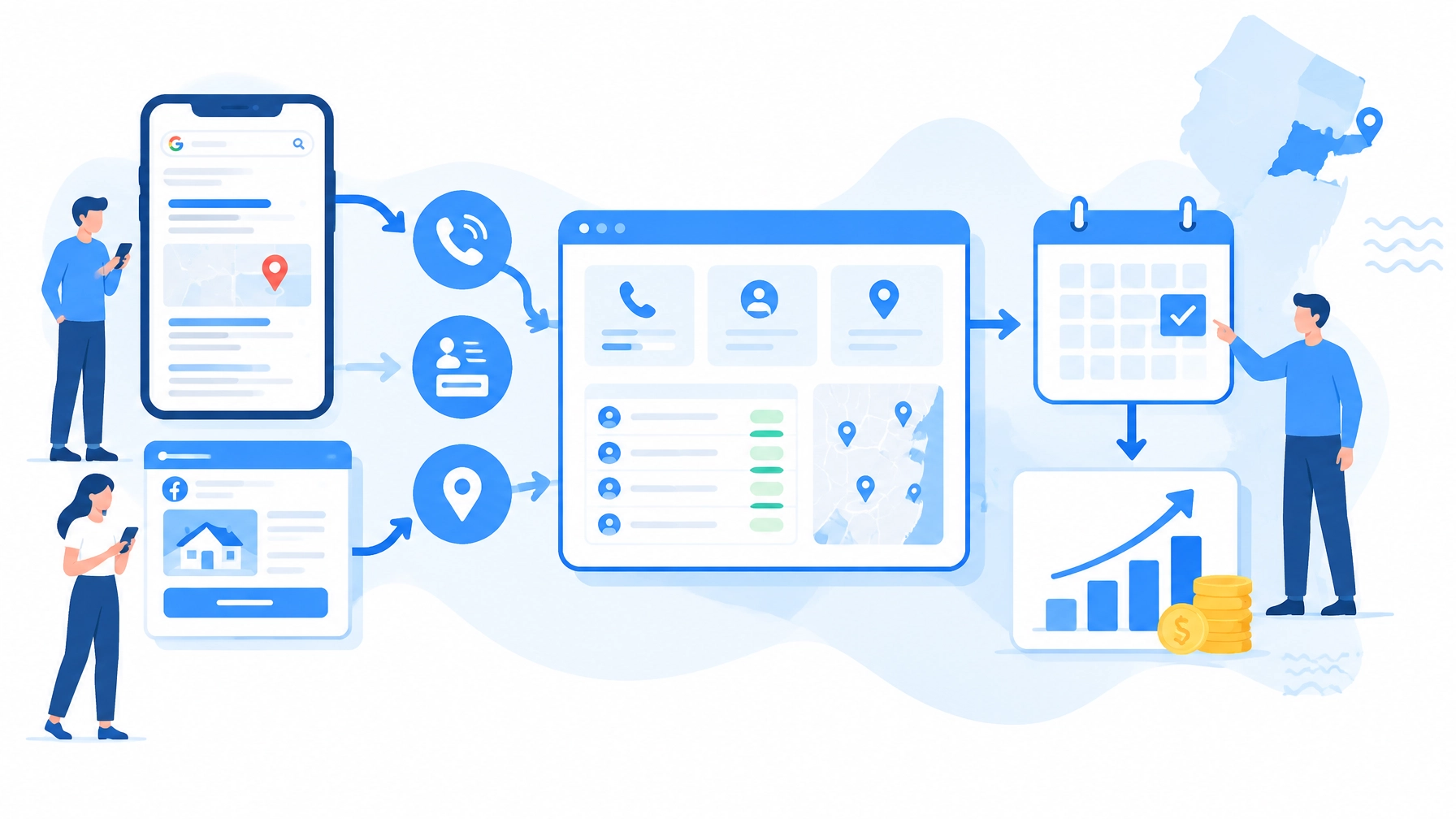
Your next customer may already be searching for you: or may need the right offer before they start searching. In Monmouth County and nearby markets, service businesses can capture both opportunities with a connected advertising system built around Google Local Service Ads and Meta Ads.
Google Local Service Ads capture high-intent prospects who are actively looking for help. Meta Ads generate both qualified lead forms and direct phone calls across Facebook and Instagram, reaching people before, during, and after their buying decision.
The objective is not more clicks.
It is more answered calls, qualified opportunities, booked appointments, and profitable jobs.
Build a Two-Channel Local Business Marketing Engine
Google LSA and Meta Ads solve different customer-acquisition problems.
| Channel | Primary strength | Best conversion actions |
|---|---|---|
| Google Local Service Ads | Captures active, high-intent demand | Phone calls, messages, and booking requests |
| Meta Ads | Creates and converts demand across the customer journey | Lead forms, calls, messages, and website conversions |
Google LSA is designed for customers searching for an eligible service in a specific area. Meta Ads use audience targeting, creative, remarketing, and campaign optimization to reach potential customers based on interests, behaviors, location, engagement, and previous website activity.
Together, they create a more complete lead engine.
- Google captures urgency.
- Meta builds consideration and generates action.
- Your sales process turns conversations into revenue.
- Tracking shows which campaigns produce booked work.
Use Google Local Service Ads to Capture Ready-to-Hire Customers
Google Local Service Ads appear prominently when people search for local providers. A customer searching for “emergency plumber near me,” “HVAC repair,” or “local personal injury attorney” is not casually browsing. They are looking for a solution.
That intent makes the phone call extremely valuable.
A live conversation gives your team the opportunity to:
- Confirm the customer’s location and service need
- Determine urgency and job scope
- Explain availability
- Answer objections immediately
- Provide an estimate or consultation
- Book an appointment before the prospect contacts another provider
Google describes Local Services Ads as a pay-per-lead program. Depending on your category and market, leads may arrive through calls, messages, or booking requests. You can review lead activity and manage your budget through the Google Local Services platform.
See Google’s Local Services Ads overview and official lead guidance.
Set the Right LSA Foundation
Before increasing spend, make sure your account supports both visibility and conversion.
-
Complete your business information.
Keep your service area, hours, phone number, categories, services, and business details accurate. -
Confirm eligibility and verification.
Google LSA availability varies by industry and location. Some categories require verification, licenses, insurance, or other documentation. -
Build review strength.
Reviews reduce hesitation and help prospective customers choose you with confidence. -
Match your service coverage to your capacity.
Do not promote areas you cannot serve profitably or quickly. -
Connect calls to a staffed number.
High-intent advertising cannot produce booked jobs if calls consistently reach voicemail.
Google’s Local Services Ads Help Center provides current information about setup, lead management, and program requirements.
Use Meta Ads for Service Businesses to Generate Calls and Leads
Meta Ads are not limited to awareness campaigns or inexpensive forms.
With the right offer, audience, creative, and follow-up process, Meta can generate:
- Direct phone calls
- Instant-form submissions
- Website quote requests
- Messenger and Instagram conversations
- Remarketing responses
- Consultation bookings
- Repeat exposure that increases future search and direct traffic
That makes Meta Ads for service businesses useful across the entire customer journey.
A person may not need a roofer today. But after seeing a storm-damage inspection offer, customer review, or before-and-after project, they may save your business, visit your website, or call when the need becomes urgent.
Match the Campaign to the Customer
Use campaign structure that reflects intent.
Prospecting campaigns
Reach people within your service area who match your ideal customer profile. Use:
- Problem-focused messaging
- Educational videos
- Before-and-after visuals
- Seasonal offers
- Customer reviews
- Clear service-area language
Call campaigns
Use direct-call campaigns when customers benefit from speaking with a specialist. Your offer might be:
- A free estimate
- A consultation
- A service availability check
- A seasonal inspection
- An urgent repair response
Your ad should make the reason to call obvious. “Call for same-day availability” is stronger than a vague “Learn More” when immediate contact is the goal.
Lead-form campaigns
Use instant forms when you need project details before a conversation. Ask only useful qualifying questions, such as:
- Service needed
- Location
- Preferred appointment time
- Project urgency
- Property type
- General budget range
Remarketing campaigns
Reconnect with people who visited your website, watched your videos, engaged with your social content, or opened but did not submit a form.
These prospects already recognize your business. Focus your message on proof, urgency, guarantees, availability, and the next action.

Set a Practical Budget Before You Scale
Your budget should reflect lead capacity, average job value, and the number of opportunities your team can handle.
A practical starting framework for a business testing both channels is:
- 60%–70% toward Google LSA and other high-intent demand capture
- 30%–40% toward Meta prospecting, calls, lead forms, and remarketing
For example, with a $3,000 monthly advertising budget, you might begin with $1,800–$2,100 for high-intent search and LSA activity, then use $900–$1,200 for Meta campaigns.
This is a testing framework: not a universal rule.
Adjust the split based on:
- Service urgency
- Average job value
- Lead quality
- Answer rate
- Booking rate
- Sales capacity
- Seasonal demand
- Cost per booked job
Do not judge performance by cost per lead alone. A lower-cost lead is not better if it never answers, qualifies, or books.
Win the First Five Minutes
Your advertising does not end when the phone rings or a form arrives.
The response process is part of your marketing performance.
Set clear operating standards:
- Answer calls live whenever possible during business hours.
- Return missed calls within five minutes when practical.
- Respond to form submissions and messages within five to 15 minutes.
- Send an immediate confirmation message after a form submission.
- Use an after-hours answering process.
- Train staff to ask consistent qualification questions.
- Record every outcome: qualified, unqualified, booked, lost, or pending.
- Review call recordings where legally permitted and with appropriate notice.
The five-minute target is an operating benchmark, not a guarantee from Google or Meta. Actual conversion rates vary by industry, urgency, competition, staffing, offer, and customer behavior.
Still, speed is one of the clearest conversion levers you control.
A missed call can represent lost ad spend, lost trust, and a lost customer who immediately calls the next provider.
Track Revenue Instead of Vanity Metrics
Your reporting system should connect advertising activity to business outcomes.
Track each channel separately:
- Ad spend
- Calls
- Answered calls
- Missed calls
- Form submissions
- Qualified leads
- Average response time
- Estimates or consultations
- Booked appointments
- Completed jobs
- Revenue
- Cost per qualified lead
- Cost per booked job
- Return on ad spend
Use this core calculation:
Cost per booked job = total advertising cost ÷ booked jobs
For example, if you spend $2,000 and generate 20 booked jobs, your cost per booked job is $100. That number is more meaningful than cost per click when your goal is revenue.
Your tracking setup should include:
- Unique tracking numbers for major campaigns where appropriate
- UTM parameters for website traffic
- CRM source and campaign fields
- Call duration and answered-call reporting
- Offline conversion imports when available
- Revenue and job-status data connected to lead sources
SEOPulseAI also provides resources on UTM tracking for GBP and ads and attribution modeling in PPC.

Optimize the System Every Month
Do not launch campaigns and wait passively for results. Treat your advertising as a revenue-generating machine that requires regular adjustment.
Review performance monthly:
- Identify services with the strongest booked-job economics.
- Remove audiences and locations producing poor-quality leads.
- Shift budget toward profitable service categories.
- Test new call-focused offers.
- Improve landing pages for high-value services.
- Compare answered-call rates by channel.
- Review call quality and staff follow-up.
- Pause campaigns when your team lacks capacity.
- Feed booked-job and revenue data back into campaign decisions.
Pair paid campaigns with a strong organic foundation. Your local SEO strategy should reinforce your ads through accurate business information, service pages, reviews, fast landing pages, clear calls to action, and consistent local signals.
When a prospect sees your ad, checks your profile, visits your website, and finds consistent proof, your business becomes easier to trust.
Partner With SEOPulseAI to Generate More Booked Jobs
You do not need disconnected vendors managing your ads, website, tracking, and local presence in separate silos.
You need a growth partner that connects the entire customer journey.
SEOPulseAI combines SEO and local growth services, paid advertising, conversion optimization, tracking, and e-commerce development. Our broader company results include:
- $25M+ in client revenue generated
- 185% average traffic growth
- 97% client retention
We use data: not guesswork: to identify where your lead engine is losing opportunities and where your next profitable improvement is most likely to come from.
Request a free, no-obligation growth consultation with SEOPulseAI today. We will review your current visibility, advertising mix, call handling, tracking, and booked-job economics, then show you practical opportunities to generate more qualified calls and leads.
More visibility is useful. More answered conversations are better. More booked jobs are the goal.