





Your next booked job depends on reaching the right prospect at the right moment. For local service businesses in Monmouth County and beyond, that usually means choosing between two powerful acquisition channels: Google Local Services Ads and Meta Ads.
Both can generate leads. They do not generate the same kind of demand.
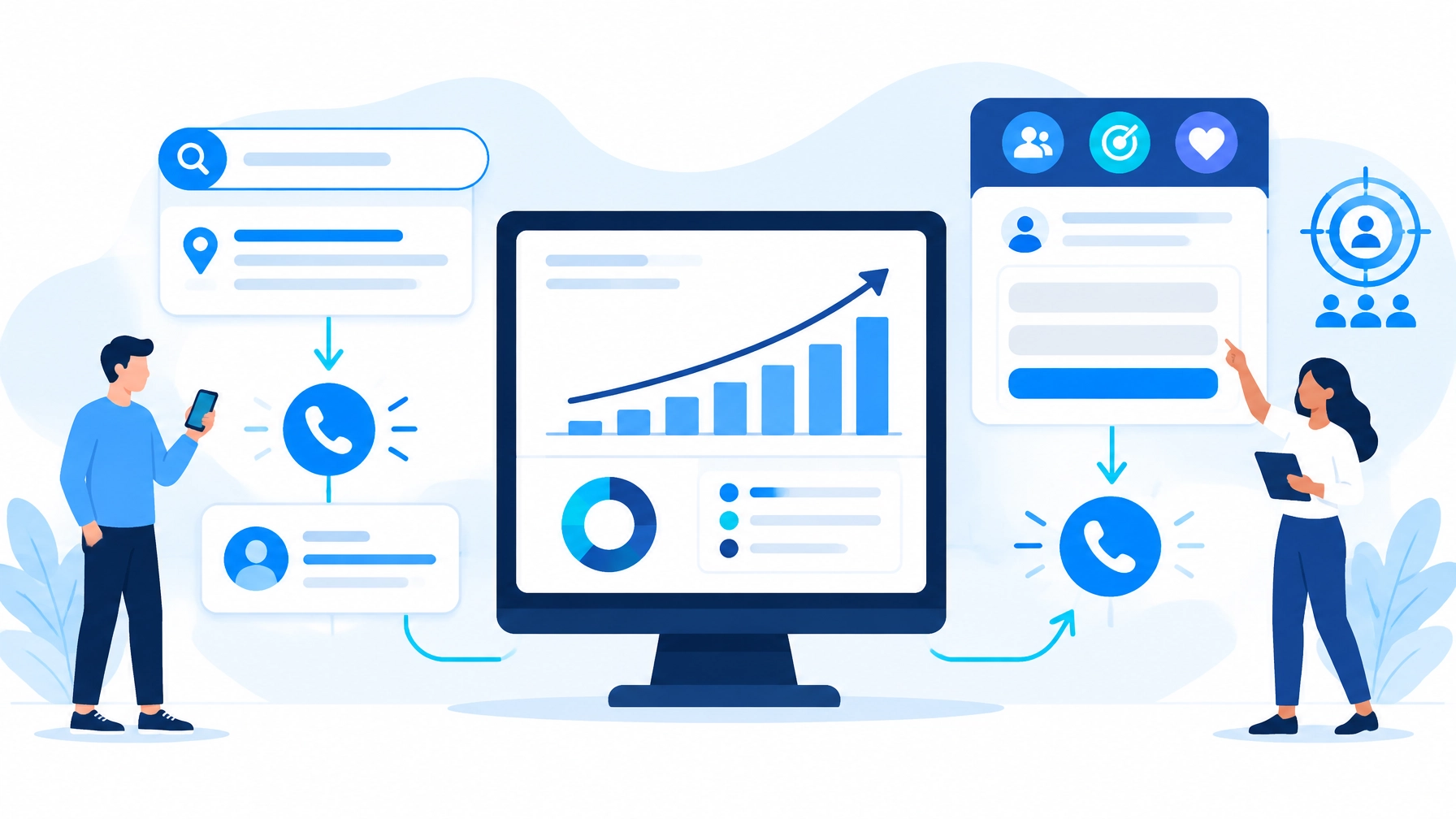
Google LSA captures people who are actively searching for a service. Meta Ads create demand, qualify prospects, build awareness, and can drive both form submissions and phone calls.
The best choice depends on your customer’s intent, your average job value, your sales process, and the conversion event that actually produces revenue.
This guide breaks down how each channel works, what it typically costs, and when you should use one, or both.
Build Your Strategy Around Booked Calls, Not Cheap Leads
A low-cost form submission is not automatically a good lead.
For many service businesses, a live phone conversation is the most valuable conversion event because it allows you to:
- Understand the customer’s problem immediately
- Qualify location, budget, urgency, and service needs
- Answer objections in real time
- Recommend the right solution
- Schedule an appointment while interest is high
Forms still matter. They create a structured pipeline for estimates, consultations, and planned projects. However, a form often creates another step: someone must contact the prospect, start a conversation, and earn the appointment.
A live call removes much of that friction.
That is why your reporting should track more than cost per lead. Measure:
- Cost per valid lead
- Cost per answered call
- Call-to-appointment rate
- Appointment-to-sale rate
- Revenue per booked job
- Customer acquisition cost
The channel with the lowest CPL is not always the channel with the lowest cost per customer.
Understand How Google Local Services Ads Work
Google Local Services Ads appear prominently when someone searches for an eligible local service, such as “emergency plumber near me,” “roofing contractor,” or “HVAC repair.”
The mechanics are straightforward:
- You create a verified business profile.
- You select your service categories and service area.
- You set an average weekly budget and bidding preference.
- Google matches your business with relevant local searches.
- Prospects can call, message, or request a booking through the ad.
- You generally pay for valid leads, not impressions or ordinary clicks.
According to Google’s official explanation of how LSA leads work, valid leads may include answered calls, meaningful voicemails, messages, emails, booking requests, and returned missed calls that result in contact.
Google also explains that lead prices vary according to location, job type, lead type, and bidding mode. Invalid or low-quality leads may qualify for credits in eligible markets and categories.
That makes LSA a strong fit for high-intent phone lead generation. The prospect is already looking for help. Your ad makes it easy to contact you immediately.
Google’s own Local Services Ads guide also highlights important performance factors, including proximity, reviews, responsiveness, profile quality, budget, and eligibility.
See How Meta Ads Create More Flexible Demand
Meta Ads operate differently. Facebook and Instagram do not wait for someone to search for your service. They use audience signals, creative, engagement, and conversion data to place your offer in front of likely prospects.
With Meta Ads, you can test several conversion locations:
- Instant forms
- Website landing pages
- Messenger or WhatsApp conversations
- Click-to-call campaigns
- Call-focused lead ads
- Retargeting campaigns for previous visitors and engaged users
Meta’s official lead ad documentation explains how Instant Forms collect information inside Facebook or Instagram. You can request a name, phone number, email address, service type, budget range, or other qualifying details.
Meta also supports lead ads with calling, allowing prospects to call your business directly from compatible devices.
This dual capability matters. Meta is not limited to inexpensive forms. You can use it to generate structured leads and drive live conversations through click-to-call campaigns.
Meta typically charges based on impressions or clicks, depending on campaign setup. Cost per lead and cost per call are performance outcomes, not fixed marketplace prices.

Compare Google LSA and Meta Ads Head to Head
The following benchmarks are directional planning ranges, not guarantees. Actual performance depends on your market, service category, reviews, creative, targeting, tracking, sales process, and competition.
| Factor | Google Local Services Ads | Meta Ads |
|---|---|---|
| Primary intent | High intent. The prospect is actively searching for a service. | Mixed intent. Prospects may be discovering, researching, or ready to act. |
| Core conversion events | Calls, messages, emails, and booking requests. | Instant forms, website leads, messages, and phone calls. |
| Cost model | Generally pay per valid lead. | Usually pay per impression or click; CPL and cost per call are measured outcomes. |
| Directional cost range | Approximately $40–$70 per valid lead for many home-service markets; $80–$150+ is possible in competitive or high-value categories. | Approximately $10–$30 per form lead for many local-service campaigns; call costs may commonly range from $20–$80 depending on targeting and creative. |
| Speed to lead | Usually immediate. A prospect calls while actively searching. | Variable. A prospect may call now, submit a form, or require follow-up and nurturing. |
| Best-fit businesses | Plumbers, HVAC companies, electricians, roofers, garage door companies, attorneys, med spas, and pest-control providers. | Renovation companies, remodelers, recurring-service businesses, new offers, higher-ticket projects, and brands that benefit from education or retargeting. |
| Creative flexibility | More limited. Google relies heavily on profile data, service categories, reviews, and verification. | High. You can test video, images, testimonials, offers, forms, audiences, and calls. |
| Best strategic role | Capture existing demand. | Create, qualify, and nurture demand. |
For context, LocaliQ reports an average LSA cost per lead of approximately $60, while SearchLight Digital’s LSA benchmark analysis reports broad variation by trade and market.
Treat these figures as planning benchmarks. Your actual economics should be based on qualified leads, booked appointments, close rate, and revenue, not an industry average.
Know When Google LSA Wins
Google LSA is usually the strongest first channel when the prospect has an urgent problem and wants a provider now.
LSA often wins for:
- Emergency plumbing
- HVAC repair and replacement
- Electrical problems
- Roofing leaks and storm damage
- Garage door repair
- Legal consultations
- Pest control
- Med spa appointments
- Locksmith services
- Other high-intent, local categories
These prospects are not casually browsing. They are actively seeking a solution.
A search-driven phone call can also create a cleaner sales conversation. You can confirm the service area, identify the problem, explain the next step, and schedule an appointment before the prospect continues comparing providers.
Choose LSA first when:
- Customers commonly search for your service by name
- The problem is urgent or time-sensitive
- Your business has strong reviews and verification
- You can answer calls consistently
- Your service area is clearly defined
- One new customer is worth substantially more than the lead cost
Your Google Business Profile and local landing page strategy should support the campaign. Strong reviews, accurate service information, and clear geographic relevance help turn visibility into calls.
Know When Meta Ads Win
Meta Ads become more valuable when the customer journey is longer or the offer requires explanation.
Meta often wins for:
- Kitchen and bathroom renovations
- Roofing replacements and larger remodeling projects
- Landscaping design and installation
- Recurring cleaning or maintenance services
- Cosmetic and elective treatments
- New service launches
- Seasonal promotions
- Higher-ticket projects
- Retargeting website visitors and past engagers
Someone may not wake up searching for a new landscaping design, cosmetic treatment, or home renovation. But a compelling visual, customer story, financing option, or limited-time consultation can create interest.
Meta also gives you more room to test messaging:
- “Get a free project estimate”
- “See what your renovation could look like”
- “Book a no-obligation consultation”
- “Call today for same-week availability”
- “Compare your repair versus replacement options”
The channel can generate form leads for planned follow-up while also driving calls from prospects who are ready to speak with someone.
The key is to optimize for quality. A cheap form filled out by an unqualified prospect is not a win. Connect your campaigns to a CRM, track qualified outcomes, and send conversion data back to Meta where possible.
Apply This Simple Decision Framework
Use these five questions before choosing your primary channel.
1. Is the customer already searching?
- Yes: Start with Google LSA.
- No or not always: Test Meta Ads to create awareness and demand.
2. Is the problem urgent?
- Yes: Prioritize phone-focused LSA campaigns and Meta call campaigns.
- No: Use Meta forms, landing pages, and retargeting to build the decision journey.
3. Does the customer need education?
- Yes: Meta gives you more creative space for video, before-and-after content, testimonials, and explanations.
- No: LSA can capture the demand directly.
4. Is your average job value high?
- Yes: Evaluate channels by booked revenue and close rate, not CPL alone.
- No: Favor the channel that produces qualified appointments efficiently.
5. Can your team handle live calls?
- Yes: Make calls a primary conversion event.
- No: Improve call coverage before increasing call-focused ad spend. Otherwise, a high-intent opportunity can become a lost sale.

Deploy a Practical Hybrid Playbook
You do not have to choose one channel permanently.
A strong hybrid strategy can work like this:
- Use Google LSA to capture urgent, high-intent searches.
- Use Meta Ads to promote planned services, offers, and higher-ticket projects.
- Run Meta click-to-call campaigns during staffed business hours.
- Use Instant Forms when you need project details, budget information, or preferred appointment times.
- Retarget website visitors and people who watched your videos or engaged with your business.
- Track calls, forms, appointments, sales, and revenue in one reporting system.
- Shift strategy based on qualified bookings: not platform-reported lead volume.
Use consistent tracking across both channels. SEOPulseAI’s UTM tracking resources for Google Business Profile and ads can help you connect campaigns to downstream outcomes.
Choose the Channel That Builds Your Growth Engine
Google LSA and Meta Ads solve different problems.
Google LSA captures existing demand from people who are ready to contact a provider. Meta Ads create demand, qualify prospects, drive calls, and nurture customers who need more time before booking.
For emergency and high-intent services, LSA is often the most direct path to booked calls. For planned projects, recurring services, new offers, and retargeting, Meta provides greater flexibility. For many businesses, the highest-performing strategy combines both.
Your decision should be based on the complete revenue path:
Qualified lead → answered call → booked appointment → closed sale → customer value.
SEOPulseAI helps you build that measurable growth engine through local SEO services, paid advertising, conversion-focused websites, and data-driven lead generation services.
Our growth partners have generated $25M+ in client revenue, delivered 185% average traffic growth, and maintained a 97% client retention rate.
Request a free, no-obligation review from SEOPulseAI to identify whether Google LSA, Meta Ads, or a hybrid strategy can produce more qualified calls and booked business for you. We will review your current visibility, conversion path, tracking, and growth opportunities: then show you the clearest next step.