





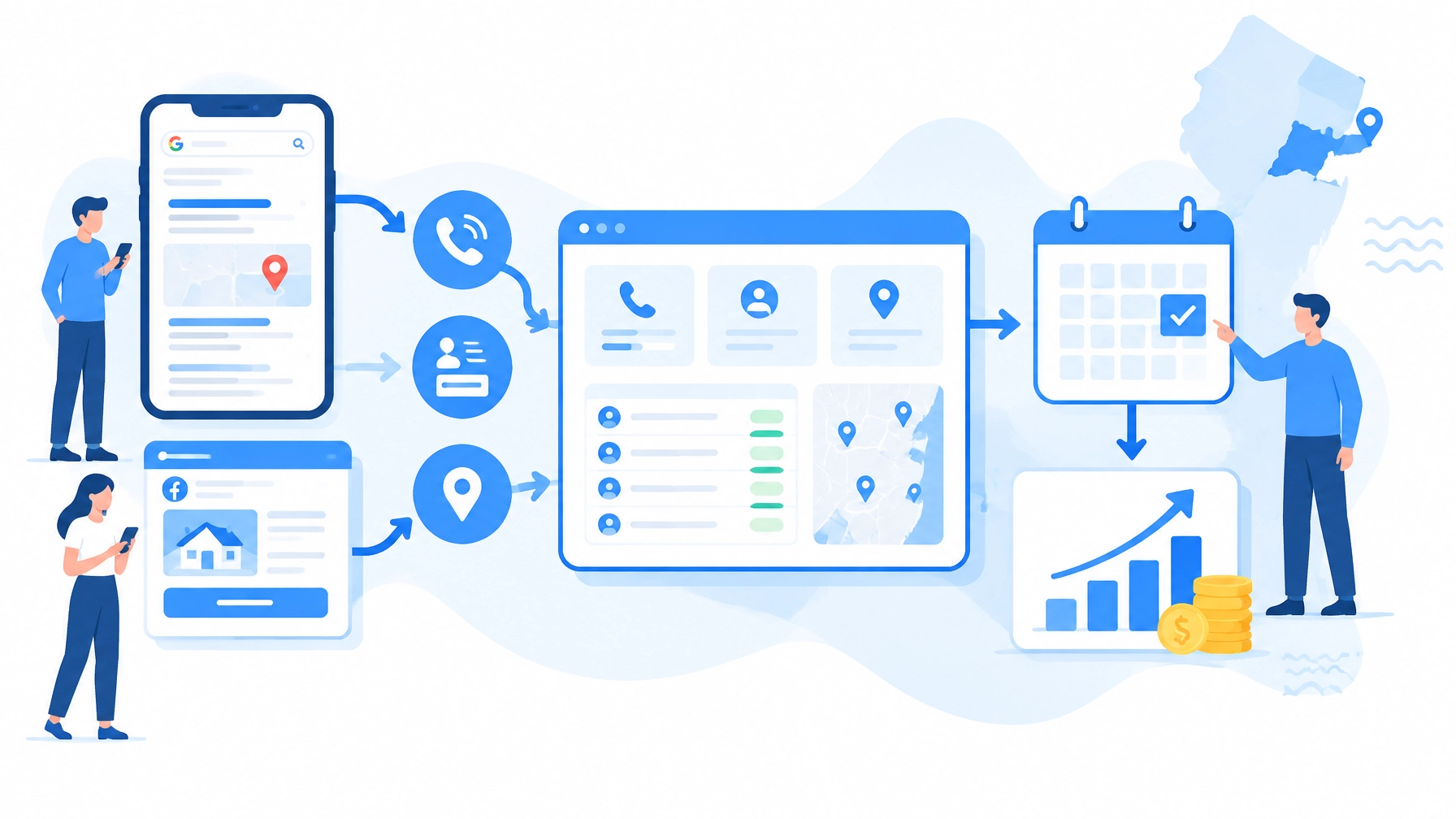
Google Local Service Ads put your business in front of people ready to hire now. Meta Ads help create demand before that search happens.
For service businesses in Monmouth County and beyond, the strongest growth strategy is not choosing one channel and ignoring the other. It is building a connected system that captures high-intent calls, creates new demand, answers quickly, and measures booked jobs.
Google Local Service Ads specialize in immediate demand. Meta Ads generate targeted form leads, direct calls, and future customers through Facebook and Instagram.
The goal is not more leads.
The goal is more answered calls, qualified opportunities, booked appointments, and profitable jobs.
Understand How Google LSA Ranking Works
Google Local Service Ads do not rank like organic search results. They also do not operate exactly like standard Google Search Ads.
Your LSA placement is determined through a combination of:
- Your bid or maximum cost per lead
- The likelihood that your ad will generate a lead
- Your business profile quality
- Your responsiveness
- Reviews and rating
- Relevance to the customer’s search
- Proximity to the searcher
- Business hours and availability
- Verification and eligibility
- Local competition and search context
According to Google’s official Local Services Ads ranking guidance, Google evaluates both your bid and how likely your profile is to produce a lead.
That means the highest bidder does not automatically win every call.
A business with a strong profile, excellent reviews, fast response times, and accurate service coverage can compete more effectively than a business that simply spends more.
Build the Quality Signals That Earn Calls
1. Respond quickly and consistently
Responsiveness is one of the most important LSA quality signals.
Google can observe how you handle customer inquiries, including:
- Whether calls are answered
- How quickly messages receive a response
- Whether you miss repeated calls
- Whether your business is available during advertised hours
- Whether customers can reach you through enabled contact options
A missed call is more than a missed opportunity. It can weaken the performance of the campaign that generated it.
Set clear operating standards:
- Answer business-hours calls live whenever possible.
- Return missed calls within five minutes.
- Respond to messages quickly.
- Use immediate SMS acknowledgments after missed calls.
- Create after-hours coverage for urgent services.
- Track every call as booked, qualified, unqualified, or lost.
A high-intent customer usually does not wait patiently. They call the next provider.
2. Grow review volume and review quality
Reviews influence both ranking and conversion.
Google considers factors such as:
- Average star rating
- Total review volume
- Review recency
- Review content
- Customer feedback patterns
There is no universal review threshold that guarantees top placement. However, maintaining a rating around 4.7 to 4.8 or higher and building a consistent stream of recent reviews is a practical competitive benchmark in many local markets.
Do not focus only on collecting more reviews. Focus on collecting better, relevant reviews.
Ask customers to describe:
- The service they needed
- How quickly you responded
- The quality of the work
- Whether the project stayed on schedule
- Why they would recommend your business
A profile with 100 reviews but no new activity can look less compelling than a profile with 60 reviews and steady recent customer feedback.
3. Keep verification, licenses, and insurance current
Many LSA categories require some combination of:
- Business verification
- License checks
- Insurance documentation
- Background checks
- Proof of professional eligibility
Google’s Local Services Ads Help Center explains that requirements vary by category and market.
Expired insurance or licenses can create serious problems. Your ad may lose its trust badge, become ineligible, or stop showing until the issue is resolved.
Treat verification as an ongoing operational responsibility. Review expiration dates, upload updated documentation, and make sure your business information is consistent across your website, Google Business Profile, and advertising account.
4. Match proximity and service area to your capacity
Google uses the searcher’s location and your service area as part of the ranking process.
A business located closer to the customer may have an advantage, especially for urgent services. However, expanding your service area too aggressively can damage performance if you cannot respond quickly or serve those locations profitably.
Set a service area based on:
- Travel time
- Staff availability
- Job value
- Local competition
- Fuel and operating costs
- Your ability to meet customer expectations
More geographic coverage is not always better. Profitable coverage is better.

Separate Bid, Budget, and Actual LSA Rank
These three concepts are easy to confuse.
Your bid
Your LSA bid is the maximum amount you are willing to pay for a lead. A higher bid can improve your ability to compete, but it does not erase weak reviews, slow response times, poor profile quality, or incomplete verification.
Your budget
Your weekly budget controls how much lead volume you are prepared to receive and helps Google pace delivery.
A larger budget may allow you to remain active longer or participate in more opportunities. But budget alone does not guarantee the highest position.
Your actual rank
LSA rank determines where your business appears among eligible Local Service providers. It is separate from:
- Organic Google rankings
- Google Business Profile visibility
- Standard Google Search Ads position
- Website SEO performance
You can rank well organically and perform poorly in LSA if your profile has weak reviews or your team misses calls. You can also appear prominently in LSA without having the strongest organic ranking.
Treat these as separate channels with connected conversion data.
Understand Pay-Per-Lead Billing
Google Local Service Ads generally use a pay-per-lead model rather than charging for every click.
Depending on your category and market, a lead may arrive through:
- A phone call
- A message
- A booking request
- A quote request
You are charged for eligible leads, not simply for impressions. Lead prices vary based on category, location, competition, service type, and market conditions.
Review your leads regularly. If a lead is clearly invalid, outside your service area, unrelated to your advertised service, or otherwise ineligible, use Google’s dispute and credit process where applicable. See Google’s official lead guidance.
The important financial metric is not just cost per lead.
It is cost per booked job.
Fix the System When LSA Calls Drop
When call volume declines, do not immediately increase the budget. Diagnose the system in order.
-
Check account eligibility.
Confirm that licenses, insurance, verification, and billing are current. -
Review answer rate.
Look for missed calls, voicemail volume, slow callbacks, and after-hours gaps. -
Inspect review momentum.
Check rating, recent review volume, and unresolved complaints. -
Confirm service coverage.
Make sure your service area, business hours, phone number, and job types are accurate. -
Review bid and budget.
Compare your activity with local competition and confirm that your budget is not capping delivery. -
Audit tracking and routing.
Test every phone number, call forwarding rule, CRM integration, and notification. -
Check seasonality and search demand.
A lower call volume may reflect market demand rather than campaign failure.
Do not optimize blindly. Find the constraint first.
Use Meta Ads to Create Demand and Generate Calls
Google LSA captures customers who are already searching.
Meta Ads help you reach customers earlier.
Meta can generate:
- Direct phone calls
- Instant-form submissions
- Website quote requests
- Messenger conversations
- Instagram inquiries
- Remarketing conversions
- Repeat exposure that creates future branded searches
With Meta’s Leads campaign objective, you can select calls or instant forms as conversion locations.
Use click-to-call campaigns when the customer benefits from speaking with a specialist immediately. Promote a clear reason to call:
- Same-day availability
- Free estimate
- Emergency response
- Consultation
- Appointment scheduling
- Service eligibility check
Use instant forms when the prospect needs to provide project details before speaking with your team. Ask useful qualifying questions about service type, location, urgency, property type, and preferred appointment time.
Meta is especially valuable for creating demand through:
- Before-and-after project content
- Customer testimonials
- Seasonal offers
- Educational videos
- Problem-focused creative
- Retargeting for website visitors and video viewers
LSA captures demand. Meta creates and nurtures demand.
Prioritize Calls, Not Just Lead Volume
Phone calls often convert better than form submissions because a live conversation removes friction.
Your team can immediately:
- Confirm the customer’s need
- Answer questions
- Explain availability
- Qualify the opportunity
- Handle objections
- Book the next step
Directional industry benchmarks often show service-business phone conversion rates around 20%–45%, while form-to-customer rates may be closer to 1%–3%. These figures vary significantly by service, offer, market, response time, and sales process.
The practical lesson is simple:
A $50 answered call may be more valuable than a $20 form lead.
Track:
- Cost per raw lead
- Cost per qualified lead
- Cost per answered call
- Booking rate
- Cost per booked job
- Cost per sold job
- Revenue by source

Keep LSA and Meta From Competing for Credit
The two channels should work together without taking credit for the same conversion.
Create a clear attribution system:
- Use unique tracking numbers where appropriate.
- Add UTM parameters to Meta landing-page URLs.
- Store source, campaign, and ad-set data in your CRM.
- Deduplicate contacts across forms and calls.
- Separate first-touch, last-touch, and assisted conversions.
- Import qualified calls and booked jobs into your reporting system.
- Measure revenue by original source and closing source.
A prospect may see a Meta ad, search for your business on Google, and then call through LSA. That does not mean one channel failed. It means the customer journey included both demand creation and demand capture.
Your reporting should show both contributions.
Measure the Number That Drives Growth
Use this formula:
Cost per booked job = total advertising cost ÷ booked jobs
For example, if you spend $2,000 and book 20 jobs, your cost per booked job is $100.
That number is more useful than impressions, clicks, or raw leads because it connects advertising to business outcomes.
SEOPulseAI brings development, SEO, paid advertising, landing pages, tracking, and conversion strategy together. Our broader client results include:
- $25M+ in client revenue generated
- 185% average traffic growth
- 97% client retention
As one client testimonial states: “They restructured our campaigns from the ground up. Our ROAS went from 1.5x to over 5.6x in just 60 days.”- Mark T., Marketing Head
Book a free, no-obligation strategy call with SEOPulseAI. We will review your LSA ranking signals, Meta campaigns, call handling, tracking, and booked-job economics.
Build the complete growth engine. Capture demand when customers are ready. Create demand before they search. Then turn more conversations into revenue.