





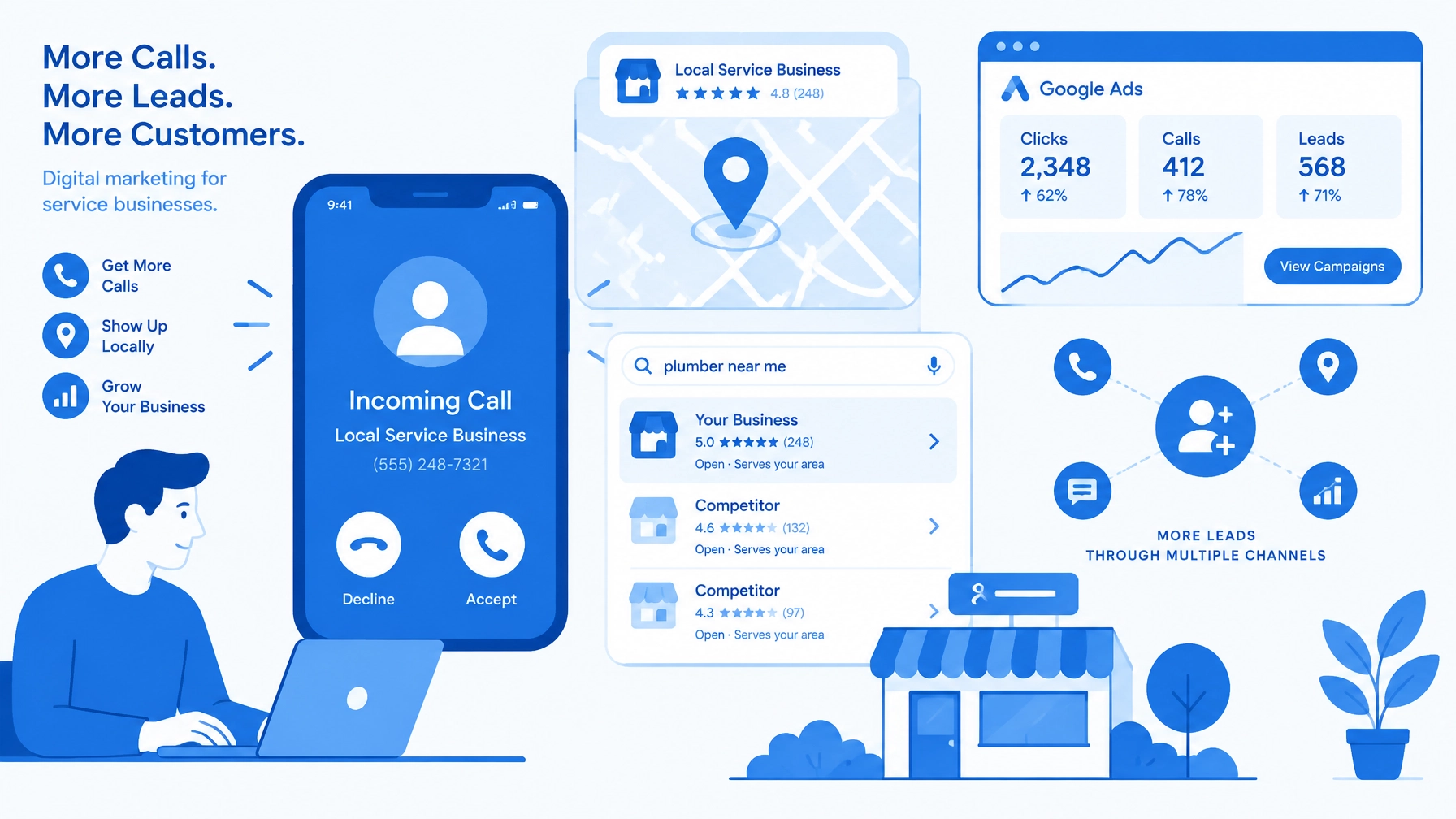
Your paid media budget should do more than generate leads. It should generate booked jobs, answered calls, and profitable growth. For service businesses in Monmouth County and beyond, that requires using Google Local Services Ads and Meta Ads for different jobs.
Google LSA captures demand from people searching for help right now. Meta Ads create demand, build awareness, retarget prospects, and can generate both qualified leads and live phone calls.
The right strategy is not choosing one platform. It is building a revenue-generating system that gives each channel a clear role.
Understand What Each Channel Does Best
| Channel | Primary strength | Best conversion actions | Best fit |
|---|---|---|---|
| Google Local Services Ads | Captures high-intent local searches | Phone calls, messages, quote requests | Emergency plumbing, HVAC repair, roofing inquiries |
| Meta call campaigns | Creates demand and drives immediate conversations | Live phone calls | Urgent offers, seasonal services, clear promotions |
| Meta Instant Forms | Generates and qualifies prospect information | Lead forms, quote requests | Roofing, landscaping, remodeling, maintenance plans |
| Meta retargeting | Re-engages people who already know your business | Calls, forms, website visits | All service categories |
Google LSA is the demand-capture engine. A prospect searches “emergency plumber near me,” sees your verified profile, and calls.
Meta is the growth layer. You can target homeowners by location, interests, behaviors, past engagement, and lookalike audiences. You can promote a seasonal offer, explain a complex service, or reconnect with someone who visited your website but did not call.
Meta should not be treated as a forms-only platform. When your offer is clear, the service is urgent, and your team answers quickly, Meta call campaigns can produce valuable conversations.
Build Your Starting Budget Split
Your ideal allocation depends on three factors:
- How urgent the service is
- The average value and margin of each job
- How much local search demand exists
Use these starting ratios as a planning framework:
-
Emergency or urgent services: 70%–85% LSA and 15%–30% Meta
Plumbing repair, drain cleaning, emergency HVAC, water damage, and similar services benefit from strong intent capture. -
High-ticket replacement services: 50%–65% LSA and 35%–50% Meta
Roofing, HVAC replacement, restoration, windows, and larger projects require more consideration. Meta can introduce financing, warranties, before-and-after results, and educational content. -
Recurring or planned services: 40%–55% LSA and 45%–60% Meta
Landscaping, cleaning, lawn care, pest control, and maintenance plans can use Meta to build demand before the customer is actively searching. -
Markets where LSA is capped: 35%–50% LSA and 50%–65% Meta
Keep enough LSA budget to capture high-intent searches, then use Meta to reach homeowners beyond the finite search pool.
If your total paid budget is below $2,000 per month, avoid spreading it across too many campaigns. Start with one focused LSA campaign and one tightly controlled Meta campaign only if you can answer calls and follow up consistently.
Use Benchmarks as Guardrails, Not Guarantees
Costs vary by trade, ZIP code, competition, reviews, response speed, and offer quality.
One 2026 home-service benchmark reported blended LSA cost per lead near $53, with approximate averages of $39 for electrical, $51 for HVAC, and $57 for plumbing. Another 2026 Meta benchmark reported an all-industry lead cost of $27.39, with home and home-improvement campaigns near $42.95.
These numbers are directional. A cheap lead is not automatically a good lead.
Your actual target should be cost per qualified lead, cost per booked call, and cost per profitable customer.

See How a $6,000 Monthly Budget Works
Assume your service business can invest $6,000 per month in paid media and serves a competitive local market.
A practical starting allocation could look like this:
- Google LSA: $3,600
- Meta call campaigns: $1,400
- Meta Instant Forms and retargeting: $1,000
That creates a 60% LSA and 40% Meta split.
The LSA budget protects your highest-intent opportunity. The Meta budget gives you room to generate calls, test offers, collect qualified inquiries, and retarget visitors.
For example:
- LSA promotes emergency service, repair, and “request a quote” categories.
- Meta call ads promote “same-day service” during staffed hours.
- Meta Instant Forms promote seasonal inspections or free estimates.
- Retargeting ads reach people who viewed your service pages but did not convert.
After 60–90 days of reliable CRM data, adjust the split in 10%–20% increments. Do not move half the budget based on one expensive week.
Make Meta Calls and Forms Work Together
Meta call campaigns work best when the prospect has a reason to speak with you immediately.
Use call campaigns when:
- The service is urgent or time-sensitive.
- The offer is easy to understand.
- Your team answers during the campaign schedule.
- You can route calls to the right person.
- The customer benefits from a quick conversation.
Meta recommends running call ads when your business can answer and using mobile-focused placements. A missed call wastes more than ad spend. It can also send a high-value prospect to a competitor.
Use Instant Forms when:
- The customer needs time to compare providers.
- The service is higher-ticket or more complex.
- You need project details before calling.
- You want to collect ZIP code, service type, timeline, or property information.
Keep forms short, but add useful qualifiers:
- Service needed
- ZIP code
- Desired timing
- Residential or commercial property
- Approximate project size or value
More questions may increase cost per lead, but they can improve lead quality and reduce wasted sales time.
Shift Your Budget With Demand and Seasonality
Do not use the same split every month.
For HVAC, increase LSA ahead of predictable heating and cooling demand. For roofing and restoration, prepare for storm-driven spikes, when lead costs and competition can rise quickly. Landscaping and exterior projects often deserve more Meta investment during the weeks before peak season.
A practical seasonal approach looks like this:
- Two to four weeks before peak demand: Increase LSA and launch Meta awareness campaigns.
- During peak demand: Protect LSA coverage and use Meta call ads for urgent offers.
- During shoulder seasons: Shift more Meta budget toward maintenance plans, inspections, financing, and educational content.
- After peak season: Retarget prior visitors and customers with recurring-service offers.
Plumbing, drain, cleaning, and other essential services may have steadier demand. Even then, monitor weekly changes rather than assuming demand is constant.
Know What to Do When LSA Is Capped
LSA is not an unlimited-demand channel. Your market may have a finite number of eligible searches, a limited service area, or too much competition for the available demand.
If your LSA campaign is capped or under-delivering:
- Confirm whether the issue is limited search demand or a budget setting.
- Review impression, lead, and budget-utilization data.
- Separate performance by service category and ZIP code.
- Check whether your profile, reviews, hours, and response rate are competitive.
- Stop increasing budget when the marginal cost per booked job becomes unprofitable.
- Move the next 10%–20% of growth budget into Meta call campaigns and qualified forms.
Google explains that LSA uses an average weekly budget, while the monthly maximum is calculated using the formula average weekly budget × 30.4 ÷ 7. Google also recommends a budget capable of supporting approximately 10 leads per week for its Maximize Leads bidding approach. Review the official LSA budget guidance before making major changes.
The goal is not to force more spend through LSA. The goal is to capture available intent, then create additional demand elsewhere.
Invest in Google Business Profile Management at the Right Time
Your Google Business Profile is the trust layer supporting both paid and organic visibility.
Prioritize professional GBP management when:
- Your review volume is behind local competitors.
- Your categories or service areas are inaccurate.
- Your photos are outdated or generic.
- Your business information is inconsistent online.
- LSA prospects frequently check your profile before calling.
- You want stronger visibility in Google Maps and local results.
GBP management does not replace paid advertising. It strengthens the credibility of the entire system.
SEOPulseAI’s local media optimization service helps businesses improve local photos, geographic relevance, profile assets, and visual trust signals.

Reallocate Based on Booked Calls, Not Cheap Leads
Track every stage of the funnel:
Spend → calls and forms → qualified leads → answered calls → booked appointments → completed jobs → revenue → gross profit
At minimum, report these metrics by channel and service:
- Cost per lead
- Cost per qualified lead
- Answered-call rate
- Missed-call rate
- Cost per booked call
- Appointment show rate
- Close rate
- Revenue per customer
- Gross-profit customer acquisition cost
A campaign with a $40 lead cost and a 50% booking rate may outperform a campaign with a $25 lead cost and a 15% booking rate.
Use call tracking, unique campaign numbers, call recordings where legally appropriate, and CRM status updates. A lead should not be considered successful until your team knows whether it became a real opportunity.
A home-services client described the impact clearly: after a focused local paid strategy, the business began receiving 20+ high-quality calls each week from targeted customers. The result came from combining local targeting, call-focused campaigns, and disciplined follow-up, not from chasing the lowest possible cost per lead.
Complete This Budget Review Every Week
Weekly checklist
- Check LSA spend, lead volume, and budget utilization.
- Review answered calls and missed calls.
- Listen to a sample of recorded calls.
- Identify junk, duplicate, and out-of-area leads.
- Compare Meta call campaigns against Instant Forms.
- Confirm ads run only during staffed hours.
- Review performance by service and ZIP code.
- Pause offers that generate volume but no booked appointments.
Monthly checklist
- Calculate cost per booked call and cost per completed job.
- Compare LSA and Meta by gross profit, not just lead count.
- Reallocate 10%–20% toward the stronger marginal channel.
- Refresh Meta creative and seasonal offers.
- Review LSA profile, reviews, categories, and service areas.
- Decide whether GBP management or landing-page improvements will unlock more value.
- Confirm your sales team follows up with every form within minutes, not hours.
Build a Paid Media System That Fills Your Calendar
LSA should capture the customer who is ready to call now. Meta should expand your reach, generate demand, drive calls, collect qualified inquiries, and keep your business visible before the search happens.
The strongest service-business strategy uses both channels as parts of one growth engine.
Partner with SEOPulseAI for professional Google Ads management and data-driven local marketing built around booked calls, not vanity metrics. Request your free, no-obligation paid media review through our contact page and discover where your next profitable customers are coming from.