





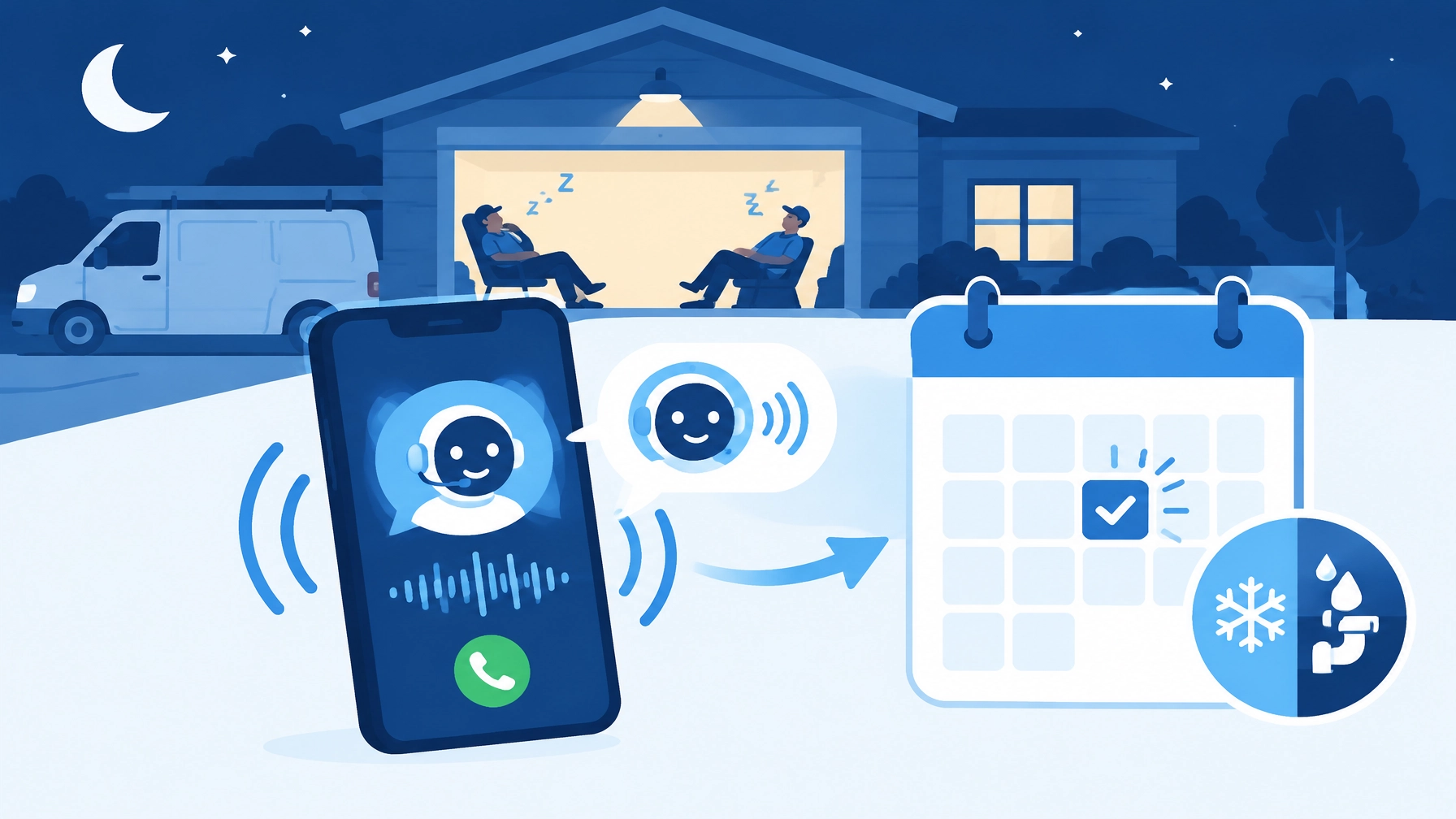
You pay for every ring, so make every answer count. For HVAC, plumbing, electrical, and other home-service companies in Monmouth County and beyond, the first 60 seconds can decide whether a high-intent caller books with you or moves on to a competitor.
AI answering services have moved from gimmick to measurable part of the growth engine. But “the phone was answered” is not the result that matters. The right question is whether bookable callers schedule an appointment during that call, and how often they need a human or a callback instead.
A March 2026 analysis offers useful benchmarks for making that decision. It compares three anonymized AI customer service representative (CSR) providers with human CSR performance, using graded conversion data from January 1 through March 4, 2026. The findings: 6,536 AI-handled conversions and 57,881 human CSR conversions. The AI providers are intentionally anonymized in The Data-Driven Trades’ “Lead Quality” analysis, which uses SearchLight Lead Grading data.
What an on-call book rate actually measures
A booking rate can mislead you if you do not know what is in the denominator. Separate bookable calls from all calls, then track why a bookable caller did not schedule.
- On-Call Book Rate: The percentage of bookable conversions where an appointment is booked during the call. This is the core measure of whether your CSR turns a viable opportunity into a scheduled job.
- Raw On-Call Book Rate: The percentage of all conversions where an appointment is booked during the call, including unbookable calls. A lower raw rate may reflect a high share of calls that could not have become appointments, not necessarily poor CSR performance.
- Human Transfer Request Rate: The percentage of bookable conversions that did not book because the caller asked to speak with a human.
- Planned Follow-Up Rate: The percentage of bookable conversions that did not book because the caller or CSR needed to follow up before scheduling.
Use all four measures together. On-call book rate shows performance; raw rate provides broader context; transfer and follow-up rates help explain the friction.
The 2026 AI CSR benchmarks
SearchLight’s “Lead Quality” series reports these results for the three-month period. The human comparison is a directional reference, not a controlled, apples-to-apples test: routing and call mix may differ, and the AI samples are substantially smaller.

| CSR group | Graded conversions | Bookability rate | On-call book rate | Raw on-call book rate | Planned follow-up |
|---|---|---|---|---|---|
| AI CSR Provider 1 | 4,788 | 48% | 59% | 28% | 14% |
| AI CSR Provider 2 | 1,401 | 22% | 40% | 9% | 14% |
| AI CSR Provider 3 | 347 | 31% | 42% | 12.6% | 24% |
| Human CSRs | 57,881 | 40% | 62% | 24% | 24% |
1. AI CSR Provider 1: 59% on-call book rate
Provider 1 posted the strongest AI result: it booked 59% of bookable conversions during the call, close to the human benchmark of 62%. Its sample contained 4,788 graded conversions, with a 48% bookability rate. Its 28% raw rate reflects all conversions, not just the bookable ones.
2. AI CSR Provider 2: 40% on-call book rate
Provider 2 booked 40% of its bookable conversions on the call. Only 22% of its 1,401 graded conversions were bookable, and its raw rate was 9%. The analysis notes that the low bookability share could be related to after-hours service calls; it should not be read as proof that the CSR itself performed poorly.
3. AI CSR Provider 3: 42% on-call book rate
Provider 3 booked 42% of bookable conversions during the call, with a 31% bookability rate and a 12.6% raw rate. Its sample of 347 graded conversions is small, so treat the result as an early benchmark rather than a final verdict.
4. Human CSRs: 62% on-call book rate
Human CSRs booked 62% of bookable conversions on the call, the strongest result in this comparison. They handled 89% of conversions in the sample. Their larger sample and potentially different call routing make this a useful bar, not a perfect head-to-head test.
What separates a 59% AI CSR from a 40% one?
The headline book rate tells you where performance lands. Transfer and follow-up data help you diagnose why.
- Transfer requests vary: 12% for Provider 1 (269 of 2,317 bookable conversions), 33% for Provider 2 (101 of 309), and 18% for Provider 3 (19 of 106). A transfer request does not automatically mean the AI is unsuitable. Manual transcript review in the study suggests caller preference and market expectations can play a role.
- Follow-up can mean different things: Provider 2 had a 14% planned follow-up rate, and 45% of those follow-ups were caller-initiated, such as needing to check with someone else. Provider 3’s rate was 24%, mostly because the AI needed to follow up after it could not book the appointment. Those are different problems and call for different fixes.
- Bookability shapes raw rates: Provider 2’s 22% bookability rate helps explain its 9% raw booking rate. Evaluate CSR skill on bookable calls; use raw performance to understand the full call mix.
For your AI answering service for contractors, review the recordings and outcomes behind these metrics. A high transfer rate may reflect customers asking for a person, a difficult call type, or an escalation process that needs adjustment. The percentage flags a question; it does not answer it by itself.
Close the follow-up trap: book while the caller is ready
The study reports that bookable conversions requiring planned follow-up become appointments only about 25% of the time on average. A callback plan is not equivalent to a confirmed job. When a caller is ready and the call is bookable, the money moment is the appointment scheduled before the conversation ends.
Use this playbook to improve on-call booking:
- Give the CSR accurate pricing and service-area context. Set clear guidance on diagnostic fees, service areas, emergency calls, and services you do not offer.
- Define booking authority. Specify which jobs and appointment types the CSR can book without waiting for approval.
- Connect a live calendar. Let the CSR see genuine availability and reserve a slot while speaking with the caller.
- Set human escalation rules. Decide when to transfer (such as for complex issues, sensitive situations, or a direct request) and make the handoff easy.
- Review the four KPIs monthly. Track on-call book rate, raw on-call book rate, human transfer request rate, and planned follow-up rate. Check call recordings when a metric shifts.

Protect the return on your paid calls
Google Local Services Ads (LSA) can generate high-intent live calls. Meta Ads can generate both calls through call ads and leads through forms. These contacts are opportunities you have paid to attract; if the phone goes unanswered or the caller cannot get a clear path to booking, that spend has less chance to produce revenue.
That is where after-hours coverage and help during call spikes can make AI answering valuable. An AI receptionist for HVAC can pick up when your technicians are on a job, your office is closed, or several calls arrive at once. But coverage alone is not the finish line. Your answering setup needs the information, calendar access, and escalation rules to turn suitable calls into booked appointments.
Decide whether AI answering fits your business
Start with the tradeoff, not the sales pitch. In this dataset, 12%–33% of bookable conversions involved a human transfer request across the three AI providers. Some callers want a person. The benchmark does not say AI answering is wrong for your business; it tells you to measure the cost and benefit in your own call flow.
- Compare your bookable on-call rate with the 62% human benchmark, while remembering the study is not perfectly apples-to-apples.
- Measure what happens to transfer requests: do callers reach a human and book, or do they drop out?
- Separate caller-initiated follow-up from CSR-initiated follow-up. They signal different obstacles.
- Test AI for overflow or after-hours calls, then review actual results before expanding coverage.
The best system is not automatically human or AI. It is the one that answers reliably, gives callers a clear path to help, and books eligible jobs with minimal friction.
Want to find the gaps between your paid leads and booked jobs? Partner with SEOPulseAI for a free, no-obligation review of your call handling and lead flow. We’ll help you assess where your marketing brings in opportunities and where your conversion process can work harder. Learn about our services or visit SEOPulseAI to get started.