





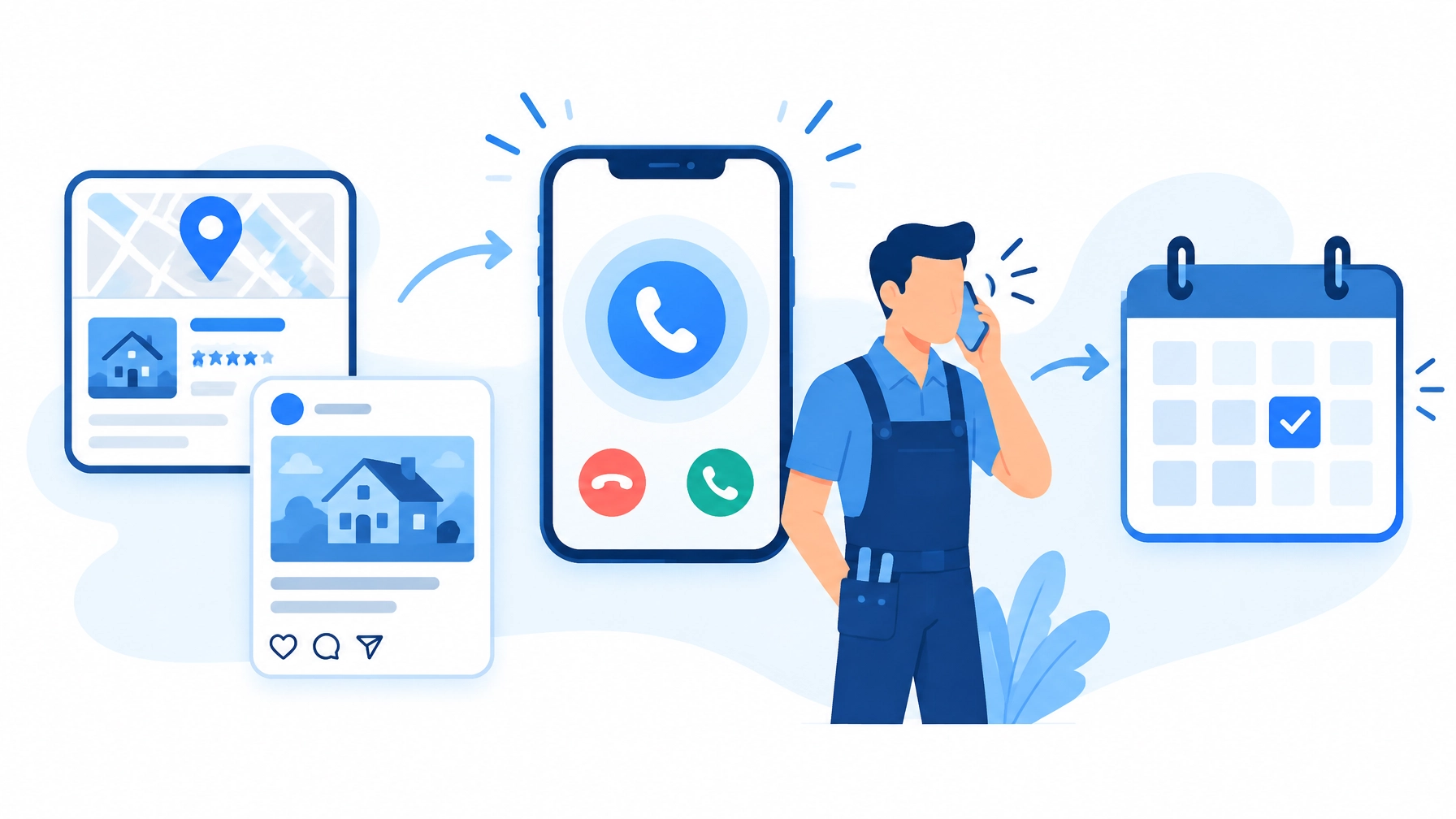
Your advertising gets the phone to ring. Your response time gets the job booked. For service businesses in Monmouth County and beyond, every missed call is a revenue opportunity handed to a faster competitor.
Google Local Service Ads and Meta Ads give you two powerful ways to generate demand. Google LSA captures people who are actively searching for a service. Meta Ads create demand, generate form leads, and drive targeted phone calls through click-to-call campaigns.
But neither channel closes the job by itself.
The real growth engine is the system connecting high-intent advertising, fast answering, disciplined follow-up, and accurate call tracking.
Build a Two-Channel Lead Engine
Google Local Service Ads and Meta Ads serve different purposes.
Google Local Service Ads capture immediate demand
Google LSA places your business in front of people searching for a specific service in a defined service area. These prospects are often ready to call, request a quote, or book an appointment.
The model is also different from standard pay-per-click advertising. According to Google’s Local Services Ads documentation, businesses generally pay for valid leads rather than ordinary impressions or clicks.
Those leads may include:
- Phone calls
- Messages
- Quote requests
- Booking requests, where available
That makes LSA especially effective for plumbers, HVAC companies, electricians, home improvement contractors, attorneys, medical providers, and other businesses where a live conversation accelerates the sale.
Meta Ads create demand and capture intent
Meta Ads are more flexible. You can use Facebook and Instagram campaigns to:
- Generate Instant Form leads
- Drive website inquiries
- Promote offers to targeted audiences
- Retarget previous visitors
- Run click-to-call ads
- Optimize toward longer, higher-quality calls
Meta’s call-focused campaign options allow you to select calls as the conversion location and test optimization goals such as call conversions or calls lasting approximately 60 seconds. You can review Meta call-ad strategies and tracking considerations before launching.
The key distinction is simple:
- LSA specializes in high-intent live calls.
- Meta generates both leads and calls across a broader audience.
Use both when your business needs consistent demand and a dependable pipeline.
Answer Faster Than Your Competitors
A lead is not a booked job until someone responds.
Research summarized by Chili Piper consistently shows that responding within five minutes dramatically improves qualification and connection rates compared with waiting 30 minutes or longer. Some studies report that businesses responding within five minutes are up to 21 times more likely to qualify a lead than businesses responding after 30 minutes.
For phone-driven service businesses, your operating targets should be:
| Response metric | Recommended target |
|---|---|
| Business-hours live answer rate | 85% or higher |
| Missed-call callback | Ideally under 1 minute |
| Competitive callback window | 1–5 minutes |
| Maximum business-hours callback window | Under 60 minutes |
| Form-lead response | Under 5 minutes |
| After-hours acknowledgment | Immediate automated text or email |
These are operating targets, not guarantees. Your actual results depend on staff availability, service category, offer quality, location, and sales process.
Still, the principle is clear: speed creates a measurable competitive advantage.
A prospect who calls two companies may book with the first person who answers. A prospect who submits a form may forget why they reached out if your team waits until the next day.

Compare Pay-Per-Lead and Cost-Per-Lead Correctly
Google LSA uses a pay-per-lead structure. Meta Ads typically charge based on ad delivery, while you measure the resulting cost per lead or cost per call.
That means you should not compare the channels using raw lead volume alone.
Third-party benchmarks commonly place LSA costs in the range of approximately $25–$60 or more per lead, depending on the market, category, competition, service type, and bidding settings. Google confirms that LSA lead pricing varies by location, category, lead type, and other marketplace factors.
Meta CPL can vary even more. A campaign may produce inexpensive form submissions but fewer qualified opportunities. A call-focused campaign may have a higher cost per conversion while generating prospects who are much closer to booking.
Track these numbers separately:
- Cost per raw lead
- Cost per qualified lead
- Cost per answered call
- Cost per booked appointment
- Cost per sold job
- Revenue generated per campaign
For example, a $25 Meta form lead is not automatically better than a $50 LSA call. If the LSA call converts at 35% and the form converts at 2%, the more expensive lead may produce substantially better economics.
Turn Calls Into Your Highest-Value Conversion Event
Phone calls often outperform forms because a live conversation removes friction. You can answer questions, establish urgency, explain pricing, qualify the job, and schedule the next step immediately.
Industry benchmarks from Invoca’s lead conversion research commonly place service-business phone conversion rates around 20%–45%, depending on industry and lead quality. Web form leads often convert at approximately 1%–3% from lead to customer.
These numbers are directional benchmarks, not promises. Your close rate depends on:
- Whether the call is answered
- How quickly you respond
- The caller’s service need
- Your pricing and availability
- The quality of your sales script
- The accuracy of your targeting
The lesson is not to eliminate forms. Meta forms are valuable when prospects are researching, comparing providers, or unavailable for a conversation.
The lesson is to give high-intent calls the priority they deserve.
Recover Every Missed Call
Missed-call recovery should be an operating system, not an occasional task.
Set up a simple recovery sequence:
- Trigger an immediate internal alert.
- Send an automatic text confirming that you received the call.
- Call back within one minute whenever possible.
- Make a second attempt within 15–30 minutes.
- Leave a concise voicemail with a direct callback number.
- Create a CRM task for additional follow-up.
- Record the final disposition: booked, qualified, unqualified, duplicate, or lost.
Your text should be helpful and specific:
“Sorry we missed your call. This is [Business Name]. We can help with your service request. Reply here or call us back at [number], and we’ll get you scheduled.”
Do not use automation as a substitute for a human response. Use it to protect the lead while your team takes over.
Cover Your After-Hours Demand
Your advertising does not stop producing interest when your office closes.
If you run LSA or Meta campaigns after hours, you need a clear coverage plan:
- Route calls to an answering service.
- Use an on-call technician or rotating staff member.
- Offer callback requests through a form.
- Enable voicemail-to-text alerts.
- Send an immediate SMS acknowledgment.
- Display accurate hours in your ads and landing pages.
- Adjust campaign schedules if no one can respond.
For emergency services, after-hours coverage may directly increase revenue. For appointment-based businesses, a fast next-morning response can protect demand without requiring a 24-hour call center.
The worst option is paying for a call you cannot answer and providing no next step.
Track, Record, and Improve Every Conversation
Call tracking connects advertising spend to actual business outcomes.
Use dedicated tracking numbers or dynamic number insertion where appropriate, and capture:
- Source and medium
- Campaign and ad set
- Keyword or audience
- Landing page
- Caller location
- Call duration
- Answered or missed status
- Lead quality
- Appointment status
- Revenue outcome
Call recording can also improve performance. Listen for patterns in:
- Missed qualification questions
- Pricing objections
- Slow response times
- Poor call routing
- Repeated customer questions
- Opportunities to improve ad messaging
Before recording calls, confirm your consent and disclosure requirements. State and federal rules can vary, and some jurisdictions require consent from all parties. Provide a clear notice when legally required and document your compliance process.

Feed Call Data Back Into Meta Ads
Meta improves when you provide better conversion signals.
Do not optimize only for clicks or cheap form fills. Connect your call tracking platform and CRM so you can identify which calls become qualified opportunities, booked appointments, and closed jobs.
Your optimization workflow should include:
- Launch a Meta Leads campaign with calls as the conversion location.
- Test click-to-call creative with a direct “Call Now” CTA.
- Create a separate campaign for Instant Forms.
- Track call duration and quality.
- Mark qualified calls in your CRM.
- Import offline conversions or send qualified events through the Meta Conversions API.
- Optimize toward booked appointments and revenue, not just lead volume.
You can also test multiple conversion locations so Meta determines whether a prospect is more likely to call or submit a form.
This creates a feedback loop:
Ad → Call or form → Qualification → Booking → Revenue → Campaign optimization
That is how you turn advertising into a revenue-generating machine instead of a collection of disconnected campaigns.
Partner With a Team That Connects Marketing and Operations
Your advertising channel matters. Your response system matters more.
SEOPulseAI is your one-stop growth partner for development and digital marketing. We build and optimize high-converting websites, manage local SEO services, create landing pages, configure tracking, and manage campaigns across Google and Meta.
Our data-driven approach has helped generate:
- $25M+ in client revenue
- 185% average traffic growth
- 97% client retention
We do not force every business into the same platform or advertising strategy. We evaluate your market, service area, sales process, technology, and growth goals, then build the right system around your business.
If your ads generate calls but your team misses opportunities, you do not need more traffic first. You need a faster, measurable conversion process.
Partner with SEOPulseAI for a free, no-obligation review of your Google Local Service Ads, Meta campaigns, call tracking, and missed-call recovery system. Find the leaks. Improve your response time. Turn more conversations into booked jobs.