





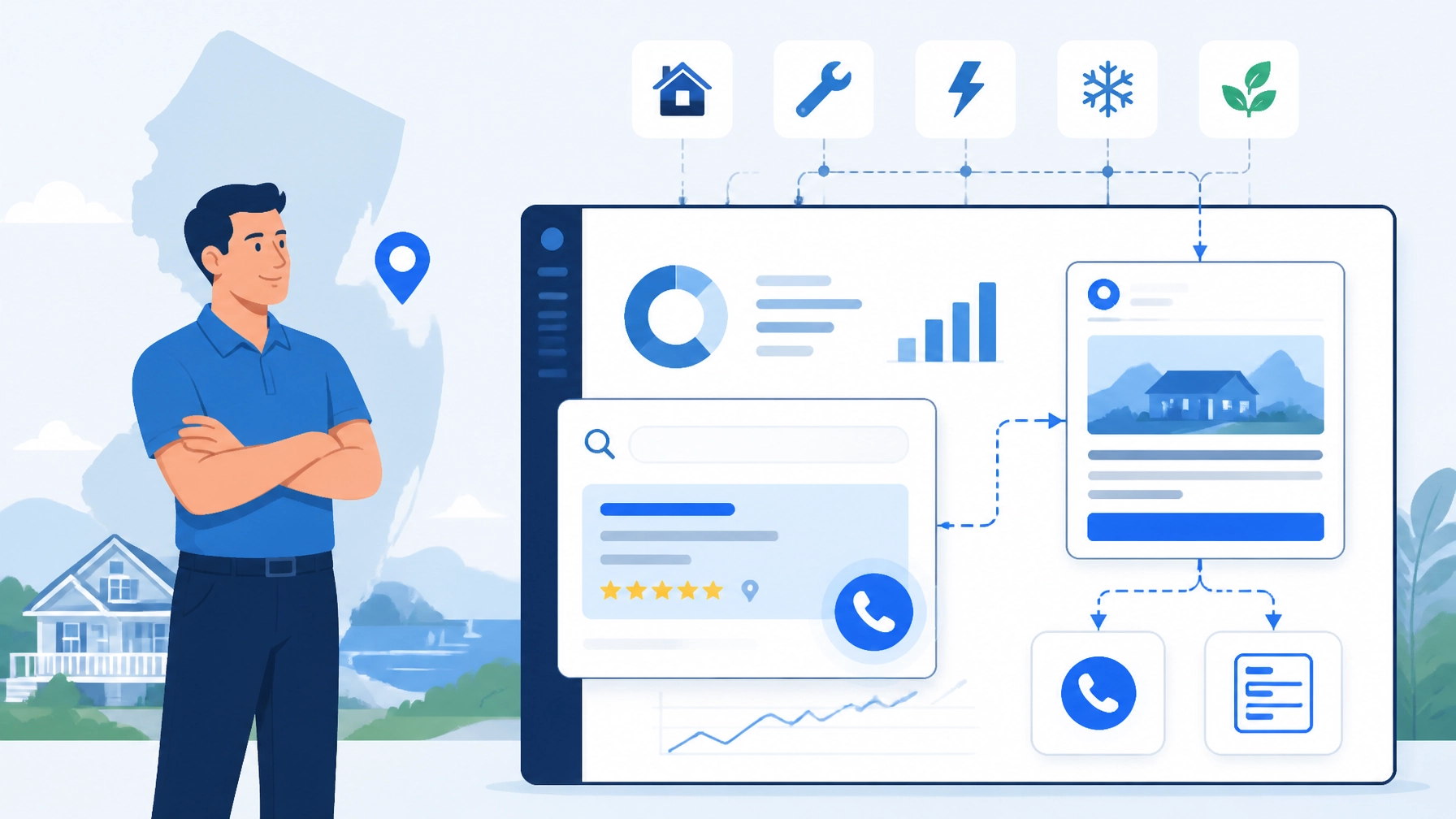
Your next booked job may start with a phone call: but the best advertising strategy gives prospects more than one way to reach you.
Google Local Services Ads (LSA) capture people who are actively searching for a provider. Meta Ads reach targeted audiences with the flexibility to generate both phone calls and lead-form submissions.
Together, they create a stronger customer acquisition system for plumbers, electricians, HVAC companies, landscapers, home contractors, and other service businesses in Monmouth County and beyond.
Google LSA captures immediate demand. Meta builds demand, creates awareness, and gives prospects a low-friction way to inquire. Your job is to connect both channels to a fast, reliable conversion process.
Build a Two-Channel Lead Engine
A service business should not rely on one advertising platform to fill its schedule.
A customer with a burst pipe may search “emergency plumber near me” and call the first credible provider they see. Another homeowner may see a Meta Ad showing a recent kitchen renovation, submit a project form, and request a consultation later.
These prospects have different levels of intent. They also prefer different ways to communicate.
Your advertising system should accommodate both.
Google LSA captures high-intent demand
Google Local Services Ads appear prominently when customers search for eligible local services. Depending on the category and location, prospects can:
- Call your business directly
- Send a message request
- Request a quote
- Schedule a booking
Google describes LSAs as a pay-per-lead format. You pay for valid leads rather than ordinary clicks, although lead pricing varies based on factors such as location, job type, lead type, and bidding mode. Google’s official LSA documentation explains how calls, messages, missed calls, voicemails, and booking requests may qualify as leads.
That structure makes LSA particularly valuable when the customer is ready to speak with someone now.
Meta Ads provide two conversion paths
Meta Ads are more versatile. They can generate:
- Direct phone calls
- Qualified lead-form submissions
Under Meta’s Leads objective, you can select calls, website and calls, instant forms, or other conversion locations. Meta’s lead-generation resources outline how businesses can use these formats to collect contact details or encourage direct conversations.
This flexibility matters because not every customer is ready to call immediately.
A homeowner researching HVAC replacement may want to compare options before speaking with a technician. A property owner looking for landscaping may prefer to submit photos and project details through an Instant Form. A customer dealing with an urgent electrical issue may tap “Call Now.”
Meta lets you serve each situation with the right next step.

Use LSA for Ready-to-Book Calls
Google LSA works best when your customer already knows what service they need.
The search itself reveals intent. Someone searching for “HVAC repair in Freehold” is not casually browsing. They likely have a problem that requires attention.
That makes LSA a powerful demand-capture channel for:
- Emergency plumbing
- Electrical repairs
- Air conditioning service
- Heating repair
- Roofing estimates
- Tree removal
- Lawn and landscape projects
- General contracting
- Home remodeling
Your LSA profile should make the decision easy.
Strengthen your LSA profile
Focus on the details that reduce hesitation:
- Select the exact services you provide
- Define your service area accurately
- Display current business hours
- Add strong business photos
- Build a consistent review-generation process
- Complete Google’s screening and verification requirements
- Use clear descriptions that explain what makes your service different
Google’s Getting Started with Local Services Ads guide confirms that customers can call, message, or book directly through the ad. It also notes that consistently failing to answer calls or respond to messages may affect ad ranking.
Visibility creates opportunity. Responsiveness converts it.
Treat every LSA call as a sales opportunity
Do not treat LSA calls as simple customer service interruptions. They are paid acquisition opportunities.
When the phone rings:
- Answer with your business name.
- Confirm the customer’s location.
- Ask what problem they need solved.
- Establish urgency and timing.
- Explain the next step clearly.
- Schedule the visit, estimate, or diagnostic whenever possible.
A strong opening might sound like:
“Thanks for calling [Business Name]. This is [Name]. How can we help you today?”
Then move quickly toward qualification:
“What issue are you experiencing, and what town is the property located in?”
The goal is not to deliver a long sales pitch. The goal is to create confidence and momentum.
Use Meta Ads to Generate Calls and Qualified Leads
Meta Ads expand your reach beyond active searchers. You can target homeowners, business owners, property managers, and other audiences based on location, interests, behaviors, and campaign engagement.
For a Monmouth County service business, that may include customers in Freehold, Howell, Manalapan, Marlboro, Wall Township, Middletown, Red Bank, and surrounding communities.
Meta gives you two important conversion options.
Drive direct calls when speed matters
Use call-focused Meta campaigns when:
- Your team answers during ad hours
- Your service has strong urgency
- The customer benefits from immediate qualification
- You have a clear offer or reason to call
- You can route calls to the right person quickly
Examples include:
- “Need emergency plumbing help? Call now.”
- “Your AC stopped working? Speak with a local technician.”
- “Request a same-week electrical inspection.”
- “Call for a free roofing estimate.”
Your creative should show the problem and the solution. Use real project images when available. Demonstrate professionalism, local knowledge, and responsiveness.
Generate leads when customers need more consideration
Instant Forms are useful when customers are interested but not ready to talk.
You can ask qualifying questions such as:
- What service do you need?
- What town is the project located in?
- Is this an emergency or planned project?
- What is your preferred service date?
- What type of property do you own?
- What is the approximate project size?
Keep forms short. Ask only questions that help your team prioritize and prepare for the follow-up call.
A lead form should also set expectations:
“Submit your details and our team will call within 15 minutes during business hours.”
That promise only works if your team can keep it.

Connect Both Channels to Call Tracking
Clicks and impressions do not pay your bills. Booked jobs do.
That means your reporting must go beyond cost per click or cost per lead. You need to understand which sources generate qualified calls, estimates, appointments, and revenue.
Track each lead by:
- Source: LSA, Meta call ad, Meta Instant Form, organic search, or referral
- Campaign and ad set
- Date and time
- Caller or contact name
- Service requested
- Location
- Call duration
- Qualified or unqualified status
- Appointment status
- Estimated job value
- Closed revenue
Google provides native lead reporting through the LSA dashboard. For Meta, use dedicated tracking numbers, CRM integrations, UTMs, and offline conversion data where appropriate.
Your core metrics should include:
- Cost per lead
- Cost per qualified call
- Call answer rate
- Lead-to-appointment rate
- Appointment-to-job rate
- Revenue per lead
- Customer acquisition cost
- Return on ad spend
A low cost per lead is not automatically a win. A more expensive lead that becomes a profitable multi-thousand-dollar project may be far more valuable than five inexpensive, unqualified inquiries.
Turn More Calls Into Booked Jobs
Advertising generates opportunities. Your call-handling process determines how many become revenue.
Create a response standard
Set clear internal expectations:
- Answer every call during business hours
- Return missed calls quickly
- Contact Meta form leads within 5–15 minutes when possible
- Use text follow-up when a caller cannot answer
- Record every outcome in your CRM
- Follow up on estimates systematically
Google specifically recognizes that returning certain missed LSA calls can matter when assessing lead validity. More importantly, returning the call gives you another chance to win the customer.
Train your team to sell the next step
Your representative does not need to close the entire job on the first call. They need to secure the next commitment.
That might be:
- A service appointment
- An on-site estimate
- A video consultation
- A diagnostic visit
- A request for project photos
- A scheduled follow-up call
Use a consistent qualification framework:
- Problem: What does the customer need?
- Place: Where is the job located?
- Priority: How urgent is it?
- Fit: Do you provide that service?
- Path: What happens next?
Consistency improves conversion and gives you better data for campaign optimization.

Create a Smarter Strategy for Monmouth County Businesses
The strongest approach is not “Google versus Meta.”
It is a connected system:
- LSA captures high-intent searches and live calls.
- Meta creates awareness and reaches targeted audiences.
- Meta call campaigns capture prospects who want immediate help.
- Meta Instant Forms capture prospects who need more time.
- Call tracking shows which campaigns create qualified opportunities.
- Your follow-up process turns inquiries into booked jobs.
This approach works across Monmouth County and throughout New Jersey because it reflects how people actually make service decisions. Some customers search at the moment a problem occurs. Others discover a provider while browsing and convert after comparing options.
You need to be present for both behaviors.
SEOPulseAI builds data-driven marketing systems that connect advertising, tracking, conversion optimization, and growth strategy. Our broader client results include more than $25 million in client revenue generated, 185% average traffic growth, and a 97% client retention rate.
Partner with a team that treats your advertising as a revenue-generating machine: not a collection of disconnected campaigns.
Explore SEOPulseAI’s digital marketing services or learn more about marketing for Monmouth County businesses. Request a free, no-obligation strategy consultation and identify where your next qualified call and booked job can come from.
Frequently Asked Questions
Are Google Local Services Ads better than Meta Ads for service businesses?
Neither platform is universally better. Google LSA is usually stronger for high-intent searches and immediate calls. Meta Ads are more flexible because they can generate both calls and lead-form submissions while reaching customers earlier in the decision process. Using both creates broader coverage.
Can Meta Ads generate phone calls?
Yes. Meta supports call-focused campaigns under the Leads objective. You can encourage prospects to call directly or use a website-and-calls setup. Your business should have reliable call tracking and a team that can answer promptly.
Should a service business focus on calls or lead forms?
Use both when your sales process supports them. Calls are valuable for urgent services and complex qualification. Lead forms are useful when prospects want to share details before speaking with someone. Test both and compare qualified appointments: not just lead volume.
What should I track from LSA and Meta Ads?
Track lead source, call answer rate, cost per qualified call, cost per lead, appointment rate, booked jobs, revenue, and customer acquisition cost. These metrics show which campaigns generate profitable customers rather than merely generating activity.