





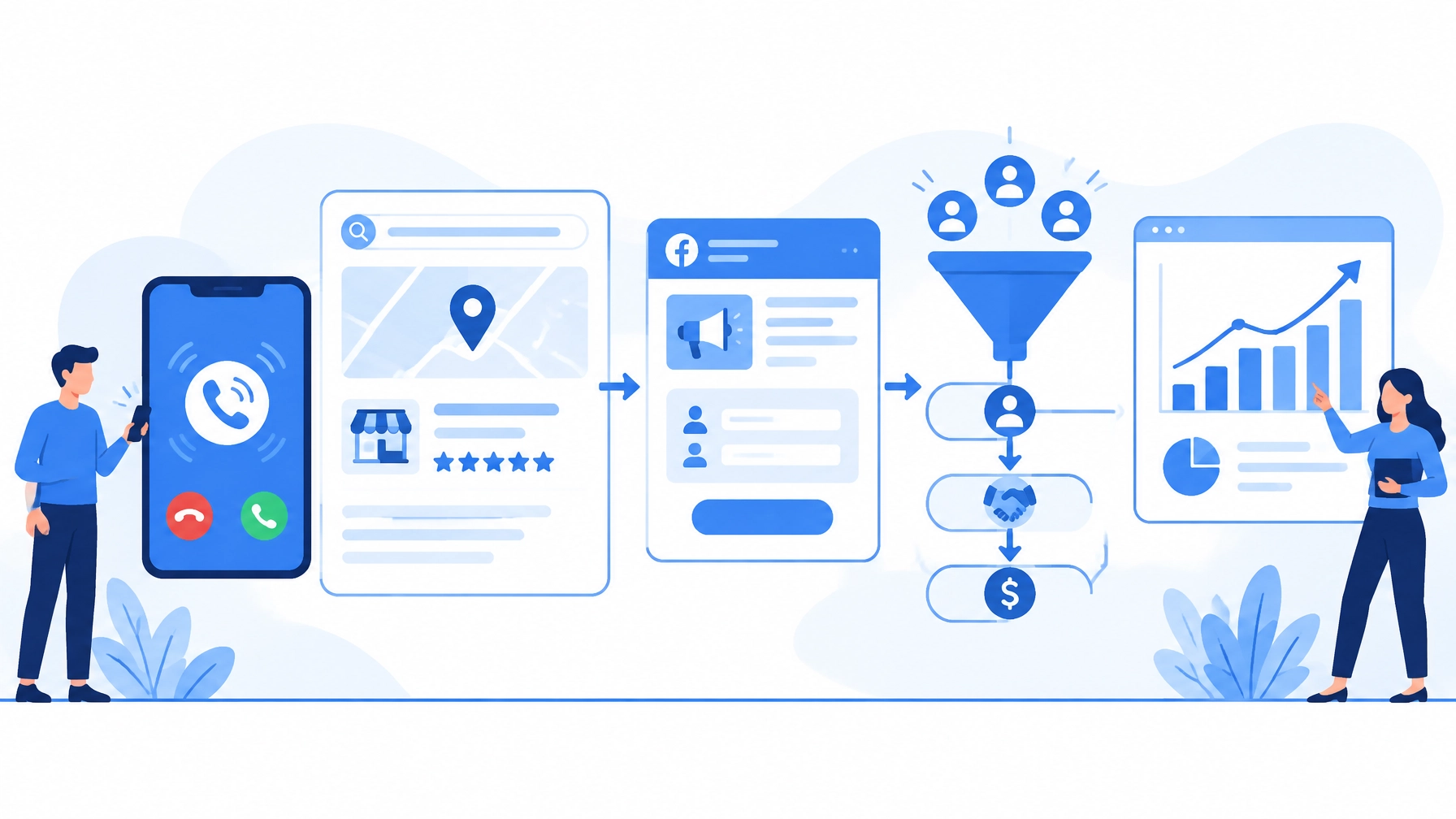
Your next customer may be ready to call right now, or may need several helpful touchpoints before submitting a lead. The strongest local business marketing strategy accounts for both behaviors.
For service businesses in Monmouth County and beyond, Google Local Service Ads and Meta Ads solve different customer problems. Google LSA captures urgent, high-intent prospects who are actively looking for a provider. Meta Ads create demand, generate form submissions, drive calls, and bring interested prospects back through retargeting.
The winning approach is not choosing one channel blindly. It is assigning each channel the right job.
Build Around the Action That Closes Jobs Faster
For most appointment-based and job-based service businesses, a live phone call remains the highest-converting action.
A conversation lets you:
- Understand the customer’s problem immediately
- Answer objections in real time
- Confirm location, availability, and service fit
- Build trust faster than a form submission
- Schedule an appointment or estimate during the first interaction
This shortens the sales cycle. It also gives your team the opportunity to turn a qualified inquiry into booked revenue before a competitor responds.
However, calls only create revenue when someone answers. Your growth engine must connect advertising, call handling, lead routing, and follow-up.
1. Capture “I Need Help Now” Searches With Google LSA
Google Local Service Ads are built for the customer who is already searching for a provider.
Their job-to-be-done is simple:
“I need this service. I want a qualified local business. I may want to speak with someone now.”
LSA placements appear prominently for eligible local searches and emphasize important trust signals such as:
- Service category
- Service area
- Customer reviews
- Business credentials
- Google screening or guarantee elements, where applicable
- Click-to-call functionality
The primary conversion is usually a phone call or message request. That makes LSA a powerful channel for plumbers, electricians, HVAC companies, roofers, legal professionals, medical practices, home improvement providers, and other businesses that close through conversation.
Use LSA when you need:
- High-intent phone calls
- Local visibility for urgent searches
- Leads from customers actively comparing providers
- A direct path from search to conversation
- Measurable cost per lead and booked-job performance
Independent 2026 benchmark reports place average home-service LSA cost per lead around $50–$60, with typical ranges from roughly $25 to $130 or more, depending on trade, competition, geography, and lead quality. SearchLight Digital reports an average of approximately $53 per lead across a large home-service sample, while other datasets show wide variation by category.
One benchmark reported a 43.9% book rate for LSA leads. Treat that as a planning reference, not a guarantee. Your actual results depend on reviews, service availability, response time, call quality, pricing, and follow-up.
2. Generate Both Leads and Calls With Meta Ads
Meta Ads solve a broader problem.
The customer may not be searching for your service at the exact moment they see your ad. They may be researching, noticing a problem, comparing options, or waiting for the right offer.
Meta’s job-to-be-done is:
“Reach the right audience, create interest, and give the prospect an easy next step.”
That next step can be a form submission or a phone call.
Meta supports several valuable pathways for service businesses:
- Instant lead forms
- Website quote requests
- Click-to-call campaigns
- Messenger or Instagram conversations
- Retargeting ads
- Educational offers and promotions
- Lookalike and first-party audience campaigns
This dual capability makes Meta more versatile than LSA. You can use the same platform to generate a pipeline of form leads and encourage high-value prospects to call.

Use Meta when you need:
- A steady flow of leads beyond active search demand
- Campaigns segmented by service, audience, or location
- Lead forms with low submission friction
- Call-focused campaigns for ready-to-talk prospects
- Retargeting for visitors who did not convert
- Creative testing to identify the strongest offers
Independent 2025 benchmarks place the average Meta lead-generation cost per lead near $27.66 across industries. For home and home-improvement services, reported averages are closer to $42.95, with many service categories landing in the $30–$50+ range.
But cost per lead is not the same as cost per customer.
A $35 form lead may require qualification, multiple follow-ups, and a sales conversation. A $60 LSA call may connect you directly with someone who is ready to schedule. Compare channels using qualified leads, answered calls, booked appointments, and revenue, not CPL alone.
3. Compare Channels by Job-to-Be-Done
| Business need | Best-fit channel | Primary conversion |
|---|---|---|
| Capture urgent local demand | Google LSA | Live phone call or message |
| Reach prospective customers earlier | Meta Ads | Lead form, website inquiry, or call |
| Re-engage site visitors | Meta retargeting | Form, call, or booking |
| Own high-intent service searches | LSA plus local SEO | Call and booked appointment |
| Educate prospects about a complex service | Meta Ads | Lead nurture or consultation |
| Maximize immediate sales conversations | LSA plus call-focused Meta | Answered and qualified calls |
The strategic distinction is clear:
- LSA captures intent.
- Meta creates and develops intent.
- Your sales process converts that intent into jobs.
4. Feed Meta Leads Into an LSA-Strengthened Call Pipeline
Meta does not compete with LSA in every situation. It can feed the pipeline that your sales team and call process close.
For example, a home-service business could:
- Run Meta Ads promoting a seasonal inspection or free estimate.
- Capture leads through an instant form.
- Call new submissions within five minutes.
- Retarget people who opened the form but did not submit it.
- Use LSA to capture customers independently searching for the same service.
- Track calls, appointments, estimates, and closed jobs by source.
This creates a full-funnel system instead of two disconnected campaigns.
Speed matters. Multiple speed-to-lead studies report that contacting an inbound prospect within five minutes can make the lead approximately 21 times more likely to qualify than waiting 30 minutes or longer. Other research has found that responding within five minutes can produce dramatically higher reach and conversion rates than delayed follow-up.
Your operating targets should include:
- Answer at least 90% of inbound calls during business hours
- Return missed calls within five minutes
- Call new Meta form leads within five minutes
- Track every call source and outcome
- Record whether each lead became an estimate, appointment, or paying customer
A lead-generation campaign without disciplined follow-up is not a growth engine. It is a leaking bucket.
5. Measure Booked Revenue, Not Vanity Metrics
A sophisticated local SEO agency or paid media partner should connect advertising performance to business outcomes.
Track the entire path:
- Impressions
- Clicks
- Form submissions
- Calls
- Answer rate
- Qualified conversations
- Appointments
- Estimates
- Closed jobs
- Revenue
- Cost per booked job
- Customer acquisition cost
- Return on ad spend
For LSA, monitor invalid leads and dispute inappropriate calls when possible. For Meta, audit lead quality instead of celebrating low CPL alone.
A useful comparison might look like this:
- LSA: $55 per lead, 80% answer rate, 44% booked-job rate
- Meta: $40 per lead, 60% contact rate, 25% booked-job rate
- Blended strategy: Meta creates volume while LSA captures urgent demand
The lower-CPL channel is not automatically the better channel. The better channel produces more profitable customers.

6. Strengthen Both Channels With Local SEO
Paid campaigns work harder when your organic presence supports them.
Your Google Business Profile, service pages, reviews, location signals, and website experience influence trust across the entire customer journey. A prospect may click an ad, then check your reviews before calling. Another may see your Meta ad, search your business name, and compare your website with a competitor.
That is why local SEO remains essential.
Your foundation should include:
- Accurate Google Business Profile information
- Dedicated pages for each core service
- Clear service-area coverage
- Consistent name, address, and phone information
- Recent, authentic customer reviews
- Fast mobile performance
- Prominent click-to-call buttons
- Conversion tracking and call attribution
- Clear guarantees, credentials, and service expectations
SEOPulseAI combines local SEO services with PPC advertising so your paid and organic visibility support one another.
Partner With a Team That Connects Marketing to Revenue
You do not need more disconnected vendors. You need one growth partner that understands acquisition, conversion, tracking, and follow-up as one system.
SEOPulseAI uses a data-driven approach across SEO, paid advertising, web development, and conversion optimization. Our published results include:
- 25M+ in client revenue generated
- 185% average client traffic growth
- 97% client retention
- 4.8x average ROAS on Meta campaigns
- 37% average reduction in CPA across campaigns
Client results reinforce the value of an integrated strategy. Mark T., a marketing head, reported that campaign restructuring increased ROAS from 1.5x to more than 5.6x in 60 days. Sarah K., a CEO, reported a 227% year-over-year revenue increase after a store rebuild and SEO engagement.
Results vary by industry, market, offer, and execution. The measurement framework does not.

Turn Calls and Leads Into a Predictable Growth Engine
Google LSA and Meta Ads are not interchangeable.
- Choose LSA to capture high-intent customers who want to talk now.
- Choose Meta to generate forms, calls, awareness, and retargeting opportunities.
- Combine both to capture demand at multiple stages.
- Respond quickly so your advertising produces conversations instead of unanswered inquiries.
- Measure booked jobs and revenue so your budget follows performance.
Ready to find out which channel deserves more of your budget?
Book a free, no-obligation consultation and marketing audit with SEOPulseAI. We will review your local visibility, LSA readiness, Meta campaign opportunities, call handling, tracking, and conversion path, then outline a practical plan to generate more qualified calls and profitable leads.