





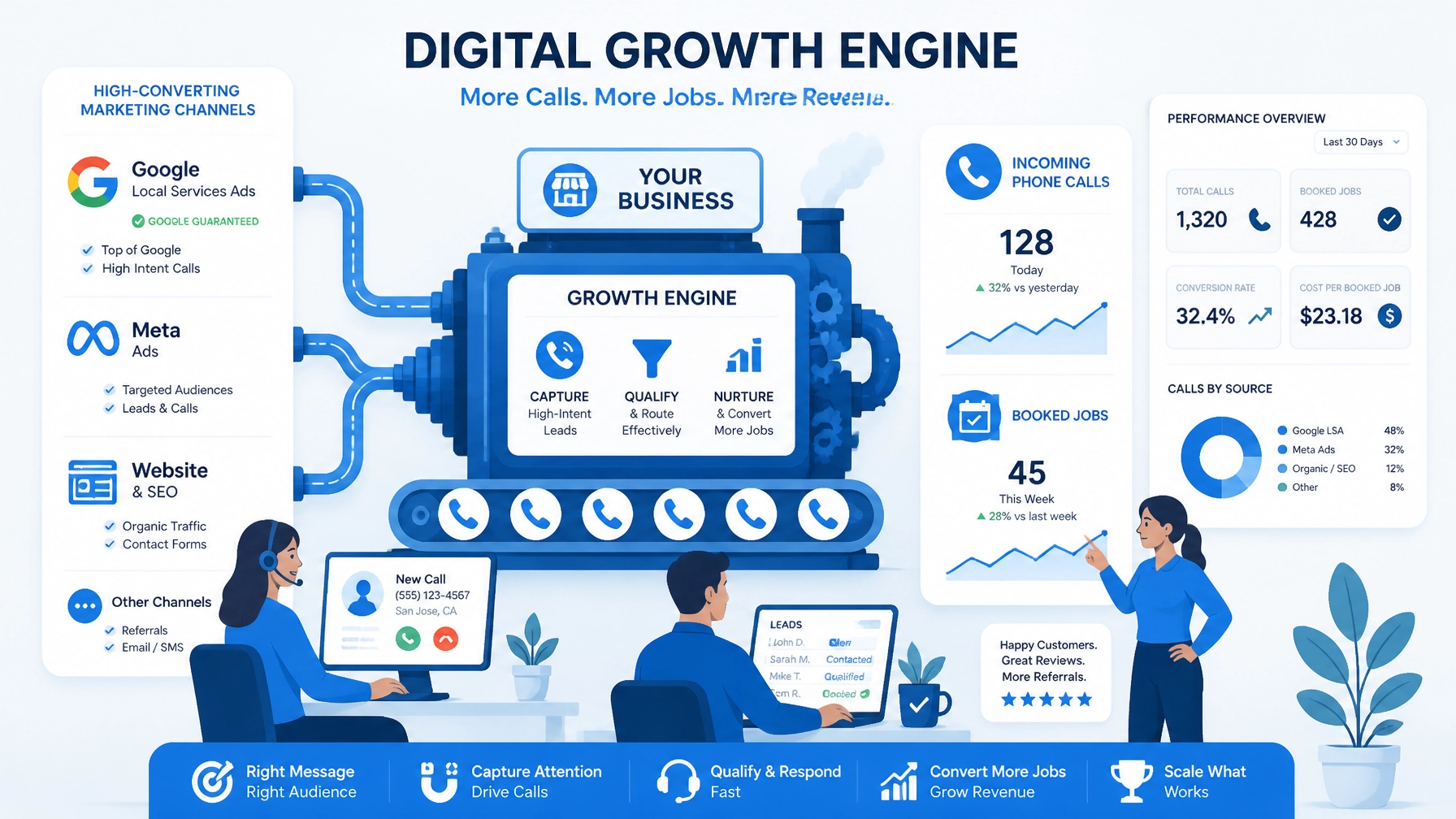
Stop treating your marketing budget like a gamble and start treating it like a high-performance engine.
For service businesses in Monmouth County and across the nation, the difference between a thriving operation and a struggling one isn't just the number of leads you generate, it’s how many of those leads you actually book into paid jobs. You don't need "more traffic"; you need more revenue. In today’s competitive digital landscape, relying on a single channel or a passive intake process is a recipe for stagnation.
To dominate your local market, you must master the operational "conversion playbook." This means combining the high-intent power of Google Local Services Ads (LSA) with the massive reach of Meta Ads, then backing it all up with a lightning-fast response system. At SEOPulseAI, we’ve seen that the magic happens after the phone rings. If you aren't optimized to handle the incoming volume, you are leaving thousands of dollars on the table every single month.
Dominate the Market with Google Local Services Ads
Google Local Services Ads (LSA) are the single most effective way to put your business at the very top of the search results page. When a homeowner in your area searches for "emergency plumber" or "HVAC repair near me," LSA puts your verified business profile above the standard paid search ads and the organic map pack.
The primary reason LSA is a "growth engine" for service pros is its focus on high-intent live calls. Unlike traditional SEO, which builds authority over time, or standard PPC, which requires constant landing page optimization, LSA connects you directly to a customer who needs help right now.
The data back this up with clinical precision. According to 2026 industry benchmarks, Google LSA leads boast an average booking rate of 43.9%. This means nearly half of every paid lead results in a scheduled appointment. Even more impressive is the financial impact: businesses utilizing a disciplined LSA strategy see an average 7.84x closed ROAS (Return on Ad Spend). With a Cost Per Lead (CPL) hovering around $53, the math is simple: LSA is the most efficient way to buy customers.
However, LSA is a "pay-to-play" system that demands operational excellence. Google tracks your responsiveness. If you consistently miss calls or take hours to reply to messages, your ranking will plummet, regardless of your budget. To win here, your team must be ready to answer the phone live, every single time.
Scale Beyond Intent with Meta Call Ads
While Google captures the "I need it now" market, Meta Ads (Facebook and Instagram) allow you to capture the "I’ve been thinking about this" market. Meta is where you build your brand and generate demand for higher-ticket, planned services like kitchen remodels, full roof replacements, or landscaping overhauls.
Many service businesses make the mistake of relying solely on Lead Forms within Meta. While Lead Forms are great for volume and longer-cycle projects, they lack the immediate urgency of a phone call. Our internal data and broader market trends show a stark contrast: Meta Call Ads convert at 10-15x the rate of web forms.
Why? Because a phone call eliminates the "friction of the follow-up." When a prospect taps your ad and their phone starts dialing your office, the sales conversation begins instantly. Statistics show that Meta call ads see 30-50% higher conversion rates compared to standard lead forms. You are catching the prospect while their interest is at its absolute peak.
We often recommend a dual-channel approach. Use Google LSA for your "bread and butter" daily calls and run Google LSA and Meta Ads together to create a comprehensive digital footprint. While LSA handles the emergency intent, Meta Call Ads fuel your growth by targeting specific demographics and interests in your service area.

The 5-Minute Golden Rule for Speed to Lead
If there is one "secret weapon" in the conversion playbook, it is Speed to Lead. In the service industry, the first company to pick up the phone or respond to a text almost always wins the job. Your prospects are not loyal to your brand yet; they are loyal to the person who can solve their problem the fastest.
The statistics on response time are staggering. Research indicates that contacting a lead within 5 minutes increases the likelihood of conversion by 9x compared to waiting 30 minutes. If you wait more than an hour, your chances of booking that job drop by over 50%. By the 24-hour mark, the lead is effectively dead.
To implement this in your business:
- Prioritize Phone Calls: Treat every incoming call from an LSA or Meta Call Ad as a five-alarm fire. It is your #1 priority.
- Automate Lead Form Responses: If you use Meta Lead Forms for larger projects, ensure an automated SMS is sent within 60 seconds of the form submission.
- Hire for Intake: As you scale, you cannot expect your technicians to be your dispatchers. You need dedicated professionals whose only job is to turn "hello" into a "booked appointment."
Build a High-Converting Intake Machine
Booking the job is a skill, not a happy accident. To maximize your ROAS from Meta and Google, your intake process must be a well-oiled machine. You are spending significant money to make that phone ring; don't let a poor conversation waste that investment.
Actionable Tips to Optimize Your Intake:
- The "Scripted" Greeting: Never answer with just "Hello?" or "Business name, hold please." Use a professional, authoritative greeting: "Thank you for calling [Your Business], the [Your County] experts in [Service]. This is [Name], how can I make your day easier?"
- Empathy First, Logistics Second: Service calls often come from stressed homeowners. Validate their problem before jumping into pricing or scheduling.
- Assume the Appointment: Don't ask, "Would you like to schedule a time?" Instead, say, "I have our lead technician in your area tomorrow morning between 8:00 and 10:00, or would the afternoon work better for you?"
- Track Everything: You cannot manage what you do not measure. Use a CRM to track where every lead came from (LSA vs. Meta), the reason for the call, and the eventual booking outcome.
Deciding between channels can be tough, which is why we developed a decision framework for choosing between Google LSA and Meta Ads based on your specific service type. Emergency services should lean into the immediate intent of LSA, while planned projects benefit from the visual storytelling of Meta.

Partner with SEOPulseAI to Fuel Your Growth
Generating leads is a technical challenge; converting them into booked jobs is an operational one. At SEOPulseAI, we don't just "run ads." We act as your growth partners, helping you build the technical infrastructure and the strategic marketing engine required to dominate your local market.
We understand that you need measurable results, not just vanity metrics like "likes" or "impressions." Our data-driven strategies have generated over $25M+ in client revenue and maintained a 97% client retention rate. We know what it takes to scale a service business from a few trucks to a fleet.
Stop guessing which platform will work and start using a proven playbook. Whether you are a local service provider in Monmouth County or a national brand looking to scale, our team is ready to help you build a high-converting revenue machine.
Ready to turn your leads into booked jobs? Partner with SEOPulseAI today.
Contact us for a free, no-obligation strategy session and let’s build your growth engine.