





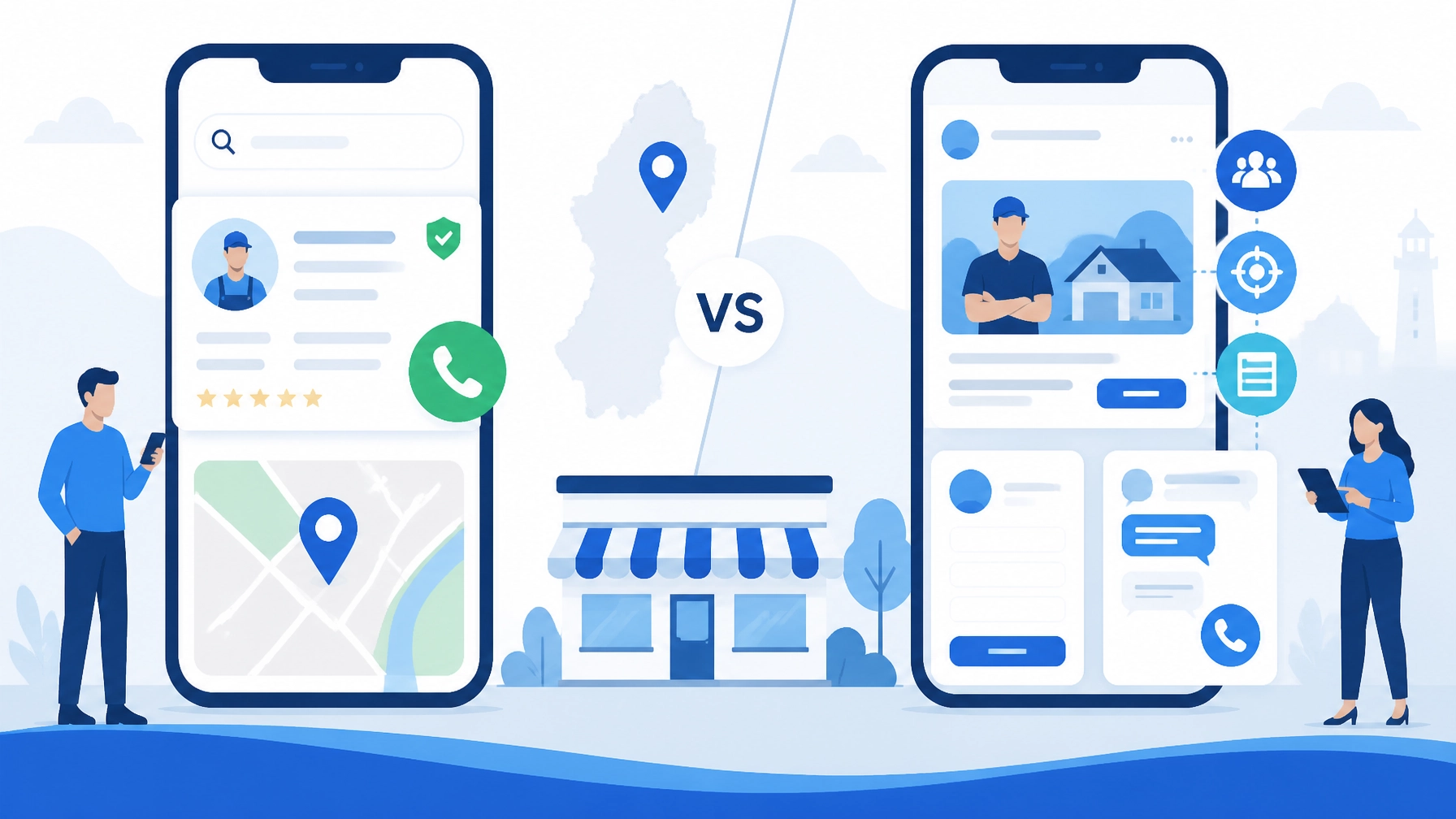
Google Local Services Ads and Meta Ads solve different growth problems. Google Local Services Ads capture demand from people actively searching for help. Meta Ads create demand, build awareness, and generate leads through forms, messages, website visits, and direct calls.
For service businesses in Monmouth County and beyond, the right choice depends on what you need most:
- More high-intent calls right now
- More total leads at a lower acquisition cost
- A stronger pipeline for future sales
- A measurable system that turns advertising into booked jobs
The short answer is clear: Google Local Services Ads usually drive more immediate, high-intent calls. Meta Ads offer broader targeting and more conversion paths, including both quality leads and phone calls.
Understand the Difference Between Intent and Discovery
Google LSA reaches customers at the bottom of the funnel.
Someone searches for “emergency plumber near me,” “Monmouth County family lawyer,” or “HVAC repair in Red Bank.” They already have a problem. They are looking for a provider. A phone call is often the fastest path to a solution.
Meta Ads work differently. They reach people while they browse Facebook, Instagram, Messenger, or WhatsApp. These prospects may need your service soon, may be comparing providers, or may not yet realize they need professional help.
That makes Meta more versatile: but often less immediate.
| Factor | Google Local Services Ads | Meta Ads |
|---|---|---|
| Primary role | Capture existing demand | Create and nurture demand |
| Typical action | Phone call, message, or booking | Form, call, message, website visit |
| Intent level | High | Low to moderate, depending on targeting |
| Best for | Urgent and local services | Awareness, lead generation, retargeting |
| Pricing model | Pay per valid lead | Usually pay based on campaign delivery and objective |
| Geographic targeting | Service areas and local search | Location, interests, behavior, lookalikes, retargeting |
| Follow-up required | Moderate | High for many campaigns |
Drive High-Intent Calls With Google Local Services Ads

Google Local Services Ads are designed for service businesses that want direct contact from local customers.
Your ad can appear prominently when people search for eligible services in the areas you serve. Customers can call, send a message, or request a booking directly from the listing.
According to Google’s official Local Services Ads information, businesses pay for customer leads rather than clicks. Google also requires eligible businesses to complete screening and verification before they can advertise.
That structure creates several advantages:
1. Capture customers when they are ready to act
A person searching for “roof repair near me” has a different mindset from someone casually watching a home improvement video. LSA puts your business in front of customers who are already evaluating providers.
2. Make phone calls the default conversion
Calls remain especially valuable for service businesses because they allow you to:
- Qualify the customer immediately
- Understand the problem in their own words
- Explain pricing and availability
- Build trust faster than a form response
- Schedule an appointment during the first interaction
- Identify urgent opportunities before competitors respond
Third-party 2025 benchmark reports frequently show that more than 90% of LSA leads arrive through phone calls in many home-service categories. Other industry benchmarks report 65%–75% contact rates for LSA calls and lead-to-customer rates commonly ranging from 20%–40%, depending on the trade, location, response speed, and sales process. These figures vary significantly by market, so use them as directional benchmarks: not guarantees. See The Media Captain’s Local Services Ads statistics and home-services advertising benchmarks from Made for Builders.
3. Build trust with Google verification
The Google Verified badge gives prospective customers another reason to consider your business. It does not replace strong reviews, clear pricing, or professional service. But it can reduce hesitation when a customer is choosing between several local providers.
Google also explains that customers can contact businesses through calls, messages, and bookings directly from the ad. Learn more through the Google Local Services Ads help documentation.
Choose LSA first when your business depends on urgent, local, phone-first demand.
That includes:
- Plumbers
- HVAC contractors
- Electricians
- Roofers
- Locksmiths
- Pest control companies
- Tree service providers
- Auto repair businesses
- Legal practices
- Dentists and healthcare providers
- Home cleaning companies
Expand Your Pipeline With Meta Ads

Meta Ads are not simply a weaker alternative to LSA. They are a broader acquisition system.
With the right campaign structure, Meta can generate:
- Instant form submissions
- Website leads
- Phone calls
- Messenger conversations
- Instagram Direct messages
- WhatsApp inquiries
- Retargeting conversions
- Appointment requests
Meta’s official lead generation resources explain that businesses can use instant forms, website forms, calling, and messaging to capture prospects. Its lead ads with calling format allows people to call your business directly from the ad.
That dual capability matters. Meta can generate both high-quality leads and calls, provided you use the right audience, offer, creative, and follow-up process.
Use Meta to reach the right audiences
Meta gives you more control over audience development. You can target people based on:
- Location, including Monmouth County municipalities and surrounding service areas
- Demographics
- Interests and behaviors
- Previous website visits
- Video engagement
- Customer lists
- Lookalike audiences
- Previous form or message activity
For example, a landscaping company could run seasonal campaigns to homeowners in Middletown, Holmdel, Freehold, and neighboring communities. A legal practice could promote a consultation offer to relevant local audiences. A dental office could retarget people who visited its services page but did not schedule.
Use the right conversion objective
Meta performance improves when the campaign objective matches the business goal.
Use:
- Calls when you want direct phone conversations
- Instant forms when you want to reduce friction
- Website and calls when prospects need more information before contacting you
- Messaging when customers prefer questions and conversations
- Retargeting campaigns when prospects already know your brand
This is where many service businesses lose efficiency. They launch a generic traffic campaign, receive inexpensive clicks, and assume the campaign is working. Clicks do not pay the bills. Qualified conversations and booked jobs do.
Industry benchmarks commonly report lower Meta lead costs than Google search-based campaigns. One 2025 benchmark places average Meta lead-generation cost at approximately $27.66 across industries, while a home-services sample reported an average near $45.50. However, lower CPL does not automatically mean higher profitability. Meta leads often require more nurturing and faster follow-up. Review the Meta home-services benchmark data from Blue Grid Media alongside your own CRM results.
Compare the Metrics That Actually Matter
Do not choose a channel based only on cost per lead.
Track the complete customer journey:
- Leads generated
- Calls answered
- Qualified opportunities
- Appointments booked
- Estimates delivered
- Jobs won
- Revenue generated
- Cost per booked job
- Return on ad spend
A $30 Meta lead that never responds is not necessarily better than a $90 LSA call that becomes a $3,000 job.
Use this simple calculation:
Cost per booked job = Total ad spend ÷ Number of booked jobs
Then calculate:
Revenue per booked job = Revenue generated ÷ Booked jobs
This approach reveals the real performance of each channel. It also helps you identify operational problems. If LSA generates calls but your team misses 35% of them, the issue may not be the ad campaign. It may be call coverage, scheduling, or response time.
Make Every Call Worth More
Phone calls are powerful because they compress the sales cycle. But only when your team handles them well.
Build a call-conversion system that includes:
- Dedicated tracking numbers
- Call recording where legally permitted
- Source attribution inside your CRM
- Call duration and quality reviews
- After-hours answering coverage
- Missed-call text-back automation
- Clear qualification questions
- Appointment scheduling during the call
- Consistent estimates and offers
- Follow-up sequences for undecided prospects
Your landing pages also matter. A slow, confusing website can waste demand from both LSA and Meta.
SEOPulseAI helps businesses strengthen the complete conversion path through PPC advertising, SEO and local search strategy, and conversion optimization support.
Combine Google LSA and Meta for a Complete Growth Engine

The strongest service-business marketing systems often use both platforms.
Use Google LSA to capture demand
Prioritize LSA when:
- Customers search for your service frequently
- Calls lead directly to revenue
- You serve a defined geographic area
- Your team can answer promptly
- Your category is eligible
- You need booked jobs quickly
Use Meta to create and nurture demand
Prioritize Meta when:
- You need more lead volume
- Your service requires education or consideration
- You have compelling visual creative
- You want to retarget website visitors
- You can follow up through phone, SMS, email, or CRM automation
- You want to promote seasonal offers or consultations
A practical budget strategy may start with LSA as the call-generation foundation and use Meta to expand reach, retarget visitors, and fill the pipeline. As your data improves, shift budget toward the campaigns producing the lowest cost per qualified opportunity: not merely the lowest cost per lead.
So, Which Drives More Calls?
Google Local Services Ads usually drive more immediate, high-intent calls for local service businesses.
They reach customers actively searching, place your business in a prominent local position, and make calling a central conversion action.
Meta Ads are more versatile. They can generate direct calls, high-quality leads, forms, messages, and website conversions. They are especially valuable when you need to create demand, build trust, retarget prospects, or generate leads at scale.
The best platform depends on your sales process:
- Need the phone to ring today? Start with Google LSA.
- Need more total opportunities and audience reach? Add Meta Ads.
- Need consistent, measurable growth? Build an integrated system and optimize for booked revenue.
SEOPulseAI is your growth partner for data-driven advertising, local visibility, conversion optimization, and digital development. Our work has generated $25M+ in client revenue, produced 185% average traffic growth, and contributed to a 97% client retention rate.
Book a free, no-obligation strategy session to identify the right call and lead-generation mix for your business in Monmouth County or beyond.