





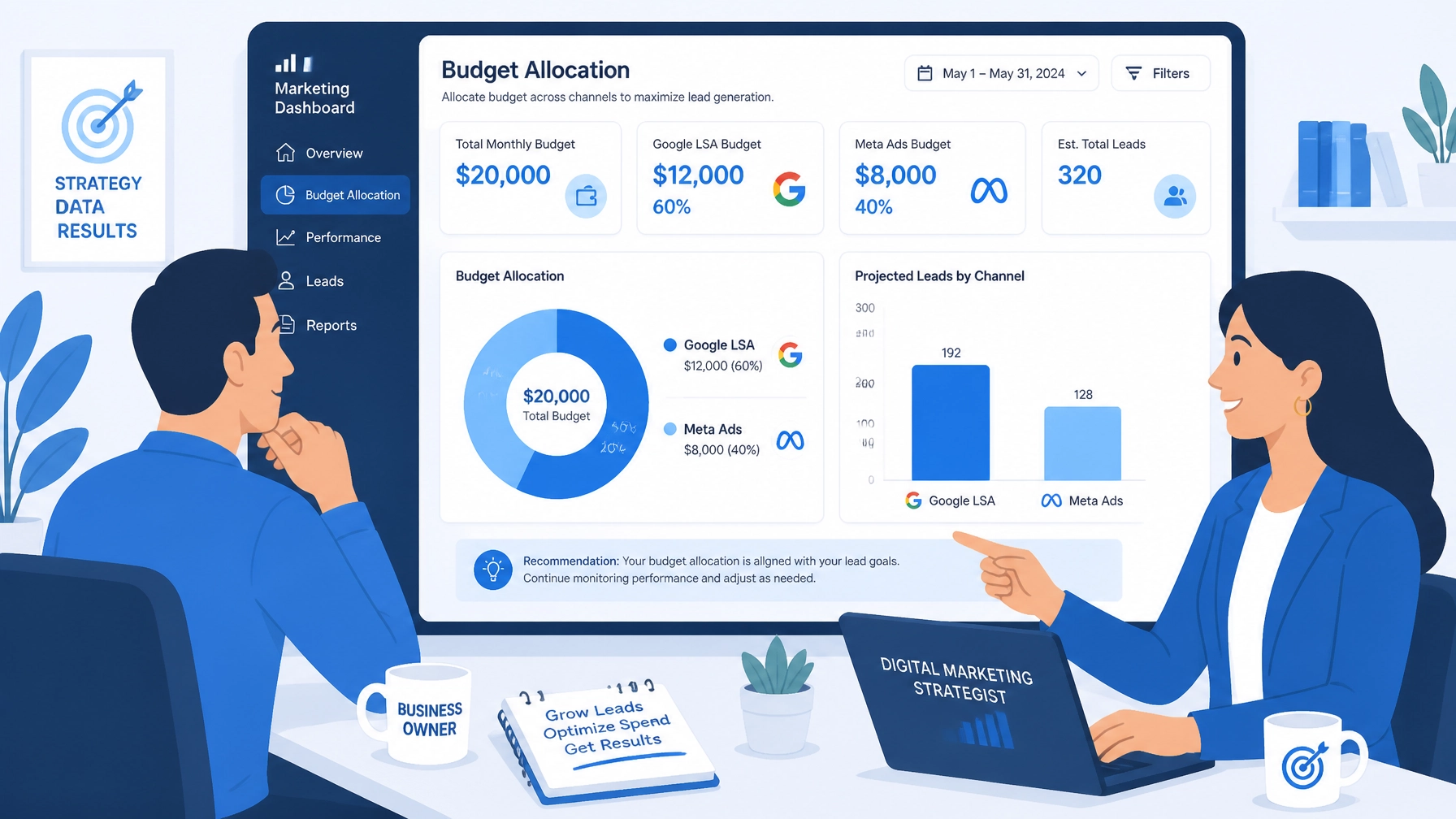
When you run a local service business: whether you are a home contractor in Monmouth County, an HVAC technician, a legal practice, or a specialized cleaning provider: every marketing dollar must act as a reliable revenue engine. You cannot afford to guess where your next customer is coming from. Yet, countless business owners throw ad spend into digital channels blindly, hoping something sticks while their cost-per-lead skyrockets and profit margins shrink.
At SEOPulseAI, we believe that scaling a service business requires a precision-engineered growth strategy. Two of the most powerful acquisition channels at your disposal are Google Local Services Ads (LSAs) and Meta Ads. However, knowing how much to invest in each platform can make the difference between a high-converting revenue machine and a burning hole in your pocket.
In this comprehensive guide, we break down how to master your budget allocation between Google LSA and Meta Ads, harness their distinct cost structures, adapt to seasonal shifts, and maximize your return on ad spend (ROAS).
Master the Core Mechanics: Google LSA vs. Meta Ads
Before dividing your budget, you must understand how each platform operates. They serve entirely different stages of the customer journey, and treating them the same will tank your conversion rates.

Google LSA: The High-Intent Call Machine
Google Local Services Ads appear at the very top of Google search results: above traditional Pay-Per-Click (PPC) ads and organic listings.
- Cost Structure: Pay-per-lead (PPL). You only pay when a prospective customer calls you or sends a direct message through the ad.
- Intent Level: Extremely high. Users searching for "emergency plumber near me" or "roof repair contractor" have an immediate, urgent need.
- Performance Metrics: Home-service benchmarks reveal that LSA cost-per-lead (CPL) hovers around $53, compared to $90.92+ on standard search. More importantly, lead-to-customer conversion rates reach an impressive 20% to 25%, driving a closed ROAS averaging 7.84x for emergency services.
Meta Ads: The Demand-Creation Engine
Meta Ads (Facebook and Instagram) operate on a push model, interrupting social media feeds to capture attention based on demographics, interests, and behaviors.
- Cost Structure: Pay-per-click (PPC) or cost-per-impression (CPM). You pay for visibility and engagement, regardless of whether a lead submits a form instantly.
- Intent Level: Medium to low (cold traffic). Users are scrolling for entertainment, not actively looking to fix a broken water heater.
- Performance Metrics: While Meta often delivers lower initial CPLs, cold traffic typically yields lower immediate close rates (1% to 3% ROAS). However, when leveraged for retargeting past website visitors or promoting seasonal offers, Meta retargeting campaigns can achieve 6x to 15x ROAS.
Pro Tip: LSAs capture existing high-intent demand; Meta creates demand and nurtures long-term brand loyalty. You need both to build an unstoppable local growth engine.
Allocate Your Budget Based on Size and Goals
How should you split your monthly ad spend? The answer depends on your total budget size, your local market competition in areas like Monmouth County, and your primary operational capacity.
1. Small Budgets ($1,500 – $3,000 / Month)
- Recommended Split: 70% Google LSAs / 30% Meta Ads
- The Strategy: When operating with tighter capital, prioritize immediate revenue. Allocate the vast majority of your funds to Google LSAs to capture ready-to-buy prospects who need service today. Use the remaining 30% on Meta strictly for website retargeting and simple brand awareness. This ensures zero wasted impressions on cold audiences while keeping your brand top-of-mind.
2. Medium Budgets ($3,000 – $7,000 / Month)
- Recommended Split: 50% Google LSAs / 50% Meta Ads
- The Strategy: This is the sweet spot for established local service businesses. With a balanced budget, LSAs capture high-intent search volume, while Meta drives lead-form campaigns for planned services (such as home renovations, landscaping, or routine maintenance) and aggressive retargeting.
3. Scaling Budgets ($7,000 – $15,000+ / Month)
- Recommended Split: 35% Google LSAs / 65% Meta Ads
- The Strategy: Google LSA volume is ultimately finite: it is capped by the total local search volume in your geographic area. Once you capture the majority of high-intent search queries and hit saturation, pouring extra dollars into LSAs leads to diminishing returns. At this stage, scale aggressively on Meta by expanding your target radius, launching video creative, and nurturing larger audiences.
Adapt Your Budget by Service Type

Not all service businesses convert the same way. Your service category dictates your ideal platform weighting:
- Emergency & "Need-Now" Services (Plumbing, HVAC repair, locksmiths, electrical emergencies): Lean heavily toward 60%–75% Google LSAs. When a pipe bursts, customers do not browse Instagram; they search Google immediately. Keep your LSA budget fully funded to secure live phone calls when intent peaks.
- Planned & Higher-Ticket Services (Home remodeling, solar installation, legal consultations, premium landscaping): Utilize a balanced or Meta-leaning split, such as 40% LSAs / 60% Meta. Because these purchases involve longer consideration cycles, Meta’s visual storytelling, customer reviews, and video walkthroughs build the necessary trust before a prospect fills out a consultation form.
Explore our expert Google Ads management services to see how we fine-tune these allocations for maximum profitability.
Scale with Seasonal Adjustments and Data Tracking
A static budget is a stagnant budget. Local service markets experience seasonal demand swings: from summer AC repairs to winter heating overhauls and spring landscaping rushes.
Adjusting for Seasonality
- Pre-Season Ramp-Up: 30 to 45 days before your peak season hits, shift 15% to 20% more budget into Meta Ads to build custom audiences and generate early interest through special promotions (e.g., "Book your spring HVAC tune-up now").
- Peak Season Capture: Once peak demand arrives, reallocate funds back into Google LSAs to capture immediate, high-intent emergency calls when homeowners need service right away.
Tracking True ROI
Stop measuring success by cost-per-lead alone. To protect your bottom line, track these metrics monthly:
- Cost Per Booked Job: How much ad spend does it take to get a completed, paid job on your calendar?
- Lead-to-Customer Close Rate: Compare how many LSA phone calls turn into paying clients versus Meta form submissions.
- Revenue Per Dollar Spent (True ROAS): Evaluate the lifetime value of customers acquired through each channel.
As your dedicated conversion optimization partners, we install robust tracking systems that connect ad clicks directly to bank deposits. Review our proven client outcomes on our portfolio page.
Dominate Your Local Market with SEOPulseAI
Balancing Google LSA and Meta Ads requires continuous monitoring, bid adjustments, dispute management for invalid LSA leads, and creative refreshes. You should be running your service business: not wrestling with ad dashboards.
At SEOPulseAI, we combine custom web development with data-driven digital marketing to build high-converting growth engines. With a track record of generating $25M+ in client revenue, achieving 185% average traffic growth, and maintaining a 97% client retention rate, we deliver measurable results you can bank on.
Ready to optimize your ad spend and scale your service business in Monmouth County and beyond?
Contact SEOPulseAI today for a free, no-obligation ad budget audit and strategy consultation.