





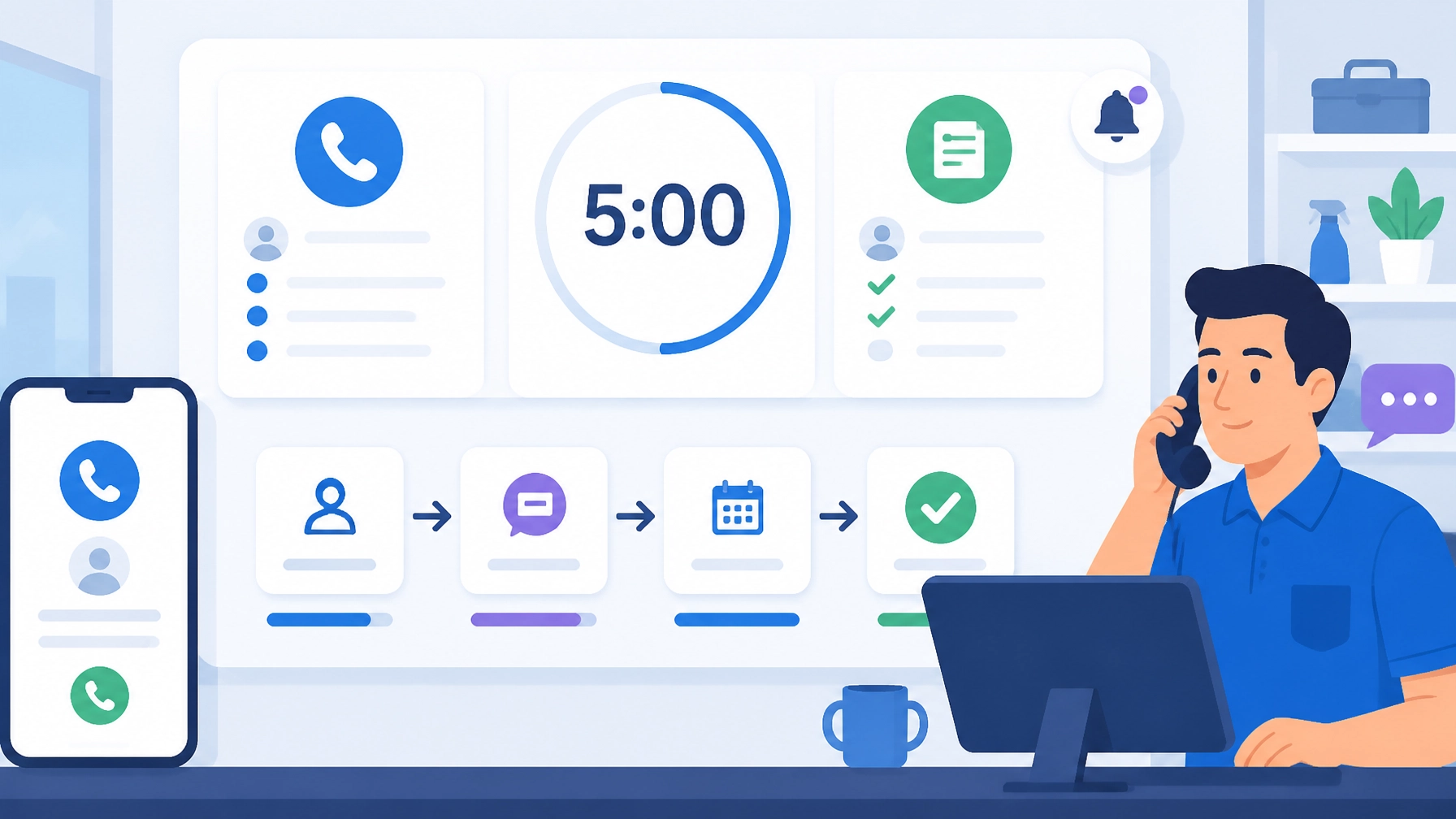
Your next booked job may depend on what you do in the next five minutes. For local service businesses in Monmouth County and beyond, generating leads is only the first step. Revenue comes from answering the call, returning the missed call, or contacting the new lead before their attention shifts to a competitor.
Google Local Services Ads (LSAs) capture high-intent prospects who are actively searching for help. Meta Ads generate both qualified lead forms and direct calls through precise audience targeting. But neither channel can overcome slow follow-up.
The rule is simple:
Respond to every new lead within five minutes. Aim for one to two minutes whenever possible.
That response standard turns advertising from a lead collection system into a revenue-generating machine.
Understand the 5-Minute Lead Rule
Speed-to-lead measures the time between a prospect’s inquiry and your first meaningful response. That response may be:
- Answering an incoming phone call
- Returning a missed call
- Calling a new form submission
- Sending a personalized text message
- Responding to an LSA message request
- Confirming an appointment or estimate request
The five-minute benchmark comes from the 2007 Lead Response Management Study, conducted by Dr. James B. Oldroyd and InsideSales.com. The study analyzed more than 15,000 web leads and over 100,000 call attempts.
Its most widely cited findings are significant:
- Responding within five minutes makes you approximately 100 times more likely to make contact than waiting 30 minutes.
- You are approximately 21 times more likely to qualify the lead within five minutes than after a 30-minute delay.
These figures are not a guarantee of conversion. They are a clear operational benchmark. The longer you wait, the more likely the prospect is to stop answering, contact another provider, or forget why they reached out.
Capture High-Intent Calls With Google LSAs
Google Local Services Ads are built for prospects who already have a problem and are actively looking for a solution.
Someone searching for “emergency plumber near me,” “roof repair,” “family lawyer,” or “HVAC installation” is not casually browsing. They are evaluating providers now. In many cases, the next action is a phone call.
That makes LSA calls especially valuable for service businesses.
Google explains that LSA prospects can contact businesses through:
- Phone calls
- Message requests
- Booking requests, where available
Google also provides a Local Services lead inbox, where businesses can review leads, contact prospects, listen to eligible call recordings, and track booked jobs.
Why LSA Calls Convert
LSAs place your business prominently in local search results and connect you with people who are already expressing demand. The strongest advantages include:
- High intent: The prospect is actively searching for your service.
- Local relevance: Ads are matched to service areas and job types.
- Trust signals: Verified profiles, reviews, photos, and Google badges reduce friction.
- Direct conversations: A live call lets you answer questions, qualify the job, and schedule the next step immediately.
However, the value of an LSA call decreases quickly when it goes unanswered.
Answer live whenever possible. If you miss the call, return it within five minutes. Do not assume the caller will leave a voicemail or try again. Many will simply call the next business in the search results.
Respond Faster to Protect LSA Performance
Response speed affects more than customer experience. Google states that consistently fast responses may improve your ad’s ranking and your ability to receive leads.
For LSA message leads, Google may display an estimated response time on your ad. That estimate can range from “a few minutes” to “one day,” depending on your recent performance and business hours. A faster visible response estimate can create an important trust advantage.
Use these standards:
- Answer LSA calls live whenever possible.
- Return missed calls within five minutes.
- Respond to LSA messages in under five minutes.
- Enable email and SMS notifications.
- Keep your business hours and service areas accurate.
- Track which leads become booked jobs, not just which leads arrive.
Google also recommends complete profiles, strong reviews, accurate job types, broad service areas, and high-quality business photos. These elements help your ad earn attention. Fast follow-up helps you convert that attention into revenue.

Use Meta Ads for Leads and Calls
Meta Ads operate differently from LSAs. Google LSAs capture existing demand. Meta Ads create and nurture demand by reaching people based on location, demographics, interests, behaviors, and engagement history.
That does not make Meta less valuable for service businesses. It makes the platform more versatile.
With Meta, you can generate:
- Instant form submissions
- Quote requests
- Appointment inquiries
- Messenger conversations
- Click-to-call interactions
- Retargeting responses from previous website visitors
- Leads from Facebook and Instagram campaigns
According to Meta’s lead generation guidance, advertisers can use Instant Forms to collect contact information without sending prospects to an external website. You can request a name, phone number, email address, ZIP code, service type, project timeline, and other qualifying details.
Meta also supports post-submission actions such as encouraging the prospect to call your business immediately. That gives you two conversion paths:
- Capture the lead for follow-up and nurturing.
- Create an immediate opportunity for a live phone conversation.
This dual capability is critical. Meta is not limited to low-intent form fills. With the right offer, creative, audience, and call-to-action, it can drive both high-quality leads and valuable phone calls.
Build a Channel-Specific Response System
Your team should not treat every lead the same. It should prioritize based on intent and urgency.
| Lead source | Ideal response | Five-minute action |
|---|---|---|
| Incoming LSA call | Answer immediately | Return missed calls within five minutes |
| LSA message | One to two minutes | Call or send a personalized reply |
| Meta lead form | One to five minutes | Call first, then send a confirmation text |
| Meta click-to-call ad | Answer immediately | Return missed calls within five minutes |
| Website inquiry | Under five minutes | Call and confirm receipt by text or email |
| Emergency request | Under two minutes | Route to an on-call representative |
Create a simple operating procedure:
1. Route Every Lead Immediately
Connect LSA notifications and Meta lead forms to your CRM or lead management system. Assign ownership automatically. A lead should never sit in an unmonitored inbox.
2. Call Before You Send a Generic Message
A phone call creates a faster path to qualification. Ask:
- What service do you need?
- Where is the job located?
- How urgent is the issue?
- When would you like the work completed?
- What is the best next step?
If the prospect does not answer, leave a short voicemail and send a text confirming that you are available.
3. Use a Clear First-Response Script
Your opening should be direct and helpful:
“Hi, this is [Name] from [Company]. We received your request about [service]. I’m calling to understand what you need and help schedule the right next step. Are you available for a quick conversation?”
Do not lead with a long sales pitch. Lead with relevance and availability.
4. Measure Booked Jobs
Cost per lead is not enough. Track:
- Response time
- Contact rate
- Qualified lead rate
- Appointment rate
- Booked-job rate
- Revenue per lead
- Cost per acquired customer
- Revenue by campaign and channel
A low-cost Meta lead that never answers may be less valuable than a higher-cost LSA call that becomes a profitable job.

Turn Speed Into a Competitive Advantage
Most businesses do not lose leads because their services are poor. They lose them because they respond too late.
The Harvard Business Review analysis of online lead response found that many companies respond slowly, and some never respond at all. That creates an opening for businesses that build a faster process.
You can gain an advantage by:
- Setting a five-minute response service-level agreement
- Using automated lead alerts
- Assigning backup coverage during busy periods
- Scheduling after-hours call handling
- Connecting forms directly to your CRM
- Reviewing missed-call reports daily
- Auditing response time by employee and channel
- Recording the final booking outcome
Automation should support your team, not replace human conversations. An instant confirmation is useful. A timely call from a knowledgeable representative is better.
Partner With SEOPulseAI to Grow Faster
LSAs and Meta Ads work best when your advertising, tracking, website, CRM, and sales process operate as one connected growth engine.
SEOPulseAI manages data-driven Google and Meta advertising campaigns designed to generate qualified leads, calls, and measurable revenue. We help you choose the right platform mix instead of forcing a one-size-fits-all strategy.
Our advertising work has produced measurable outcomes, including:
- $25M+ in client revenue generated
- 185% average traffic growth
- 97% client retention
- Reported results such as a 50% reduction in CPA
- Campaigns achieving up to 6x ROAS
- A reported 45% decrease in cost per lead while qualified leads tripled
As your growth partners, we look beyond impressions and clicks. We connect campaign performance to calls answered, appointments scheduled, jobs booked, and revenue generated.
Do not let your next LSA call or Meta lead go cold. Contact SEOPulseAI for a free, no-obligation advertising audit and discover how to build a faster path from lead to booked job.